Patterns
A State on the Shaft: Where the Designs Come From
The state design is the most American thing on an arrow wrap. The desk reads it as a printing problem before a decoration.
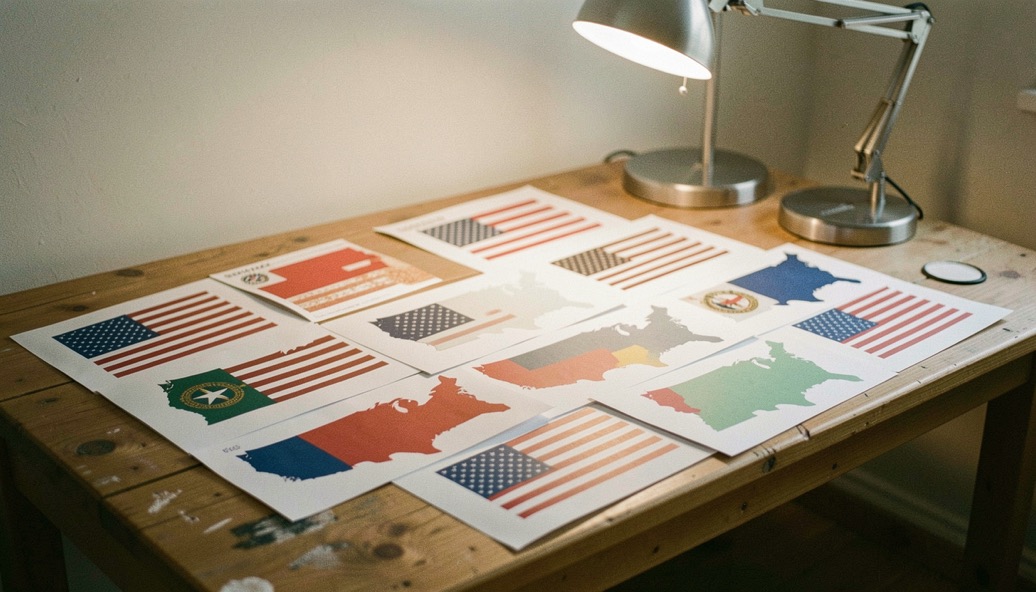
Of everything printed on an arrow wrap, the state design is the most local and the most legible. A band two fingers wide carrying the flag of a state is read at arm's length by anyone who grew up with that flag, and by nobody else, which is a very particular kind of marking for a piece of archery equipment. The desk reads the habit first as a record, then as a printing problem.
What the record holds
The shop that used this domain until 2020 left a catalogue on the record, and the catalogue is countable. Forty nine product addresses are archived from it. Their codes carry the two letter abbreviations of thirty one states, from Alaska and Alabama to Washington, in forms that repeat a single scheme: the state abbreviation, then classic or standard, then where a variant exists a color word. Four addresses carry opaque identifiers instead of codes, and the captures resolve them to the same scheme: Illinois, Montana, South Dakota and Florida, in the standard finish like the rest.
Beside the state line, the same catalogue held a geometric line and a custom wrap, and the geometric line is read on its own in the hex line and colorways. What the catalogue did not hold is as informative as what it did. It carried no gauge options and no length options, so the thirty one states were printed on one film and cut to one template, and any division of those forty nine sheets by thickness or by length would be an invention. The desk does not make it.
Which thirty one states, and which nineteen are missing
The list is worth printing, because it is the half of the record that cannot be reconstructed from memory. The catalogue carried Alabama, Alaska, Arizona, Arkansas, California, Colorado, Florida, Georgia, Idaho, Illinois, Indiana, Iowa, Kansas, Kentucky, Louisiana, Michigan, Missouri, Montana, Nebraska, Nevada, New Mexico, North Carolina, North Dakota, Ohio, Oklahoma, Oregon, South Carolina, South Dakota, Texas, Utah and Washington. Several of them appear more than once, in a second finish or a second color, and Texas and Colorado and New Mexico carry the most variants of all.
The nineteen the record does not hold are Connecticut, Delaware, Hawaii, Maine, Maryland, Massachusetts, Minnesota, Mississippi, New Hampshire, New Jersey, New York, Pennsylvania, Rhode Island, Tennessee, Vermont, Virginia, West Virginia, Wisconsin and Wyoming. Thirteen of those nineteen sit in the Northeast or on the mid Atlantic seaboard, and the desk offers that as a reading and not as a finding: a catalogue is evidence of what one seller stocked, never of where a design was wanted, and an address that a crawler never captured is not the same thing as a design that was never printed.
Why a state, and why there
The reasons a hunter puts a state on an arrow are not documented in the archive, and the desk does not invent them. What the archive supports is narrower: the designs were sold, they were sold in quantity, they covered thirty one of the fifty states, and they were the largest family in the catalogue. A habit that wide in one catalogue was not an experiment.
The form of the marking explains part of its appeal without any speculation about motive. A wrap is the cheapest printed surface on the equipment, it is applied in minutes, it is read at a distance of a few feet by the people standing at the same target, and it can be taken off again without touching the shaft. A sticker on a quiver does most of the same work; a wrap does it on the thing that flies.
What a state design asks of the film
Flags are easy and seals are not. The field of a flag is one or two colors and a simple figure, and it survives being printed at any size and cut almost anywhere. A seal is a different order of problem: it carries lettering around a ring, figures at its center and lines that mean nothing once they blur, and all of it has to survive on a band about as wide as a finger.
That is where the film under the print earns its keep. Fine rules and small lettering hold on a smooth, thin, cast film and lose their edges on a coarser one, and the catalogue's own description put the wraps on 2 mil vinyl. The two films behind that figure, and how to tell them apart at a bench, are read in cast against calendered vinyl.
The color work asks something of the film too. A state design carries colors that are named in law and recognized at sight, and a print that arrives on the shaft one shade off is read as the wrong state's colors by the people most likely to be looking at it.
Design, cut and coverage
A design that concentrates its detail in one place constrains the cut: the seam cannot cross a seal, so it falls in the quiet ground beside it, and the width of that quiet ground sets the overlap the pattern can carry. A design built on a field is free of that constraint and hides its own seam. The mechanics of the crossing, and what the doubled film does to the print, are in cut lines and overlap.
The band itself occupies the cresting area of the shaft, and how much of the tube a printed band covers, and what stays bare at either end of it, is the subject of shaft coverage. The designs are the last layer on a stack of decisions about film, adhesive and cut, and the desk reads them in that order.