Length and cut
Coverage: How Much of the Tube a Wrap Takes
A wrap is a band, not a coat. Where the band starts, where it stops, and what the bare tube does at both ends.
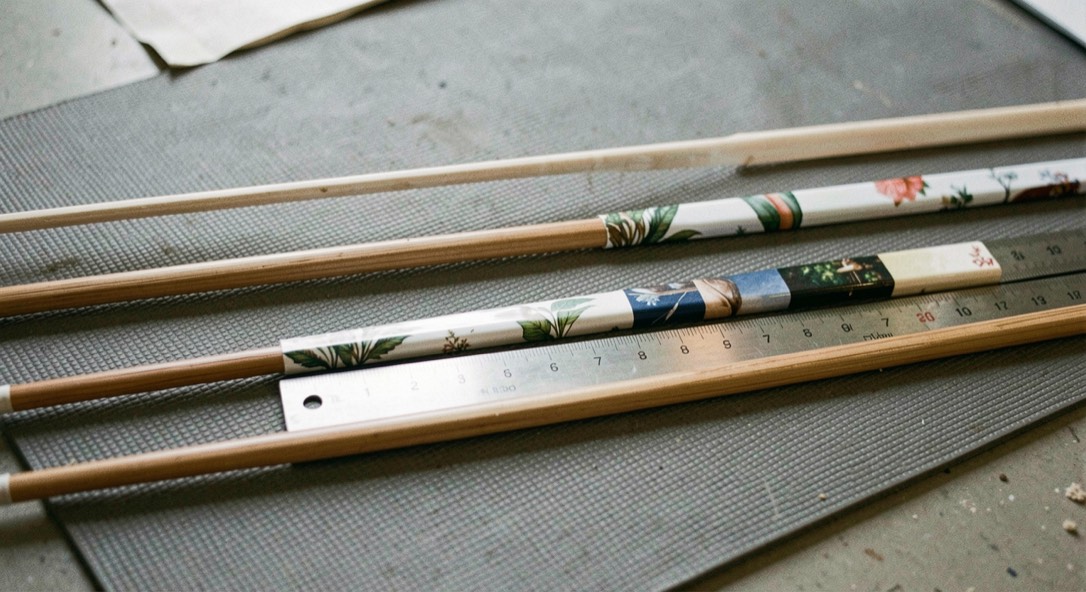
A wrap is a band, not a coat. Nothing on the market covers a shaft from nock to point and nothing aims to, because the tube has jobs that a film would get in the way of. What the band covers, what it leaves bare, and where the two meet are the three reads this page makes, and each of them is decided by the shape of the shaft rather than by the design printed on the film.
The three regions of a tube
An arrow shaft is not a cylinder from end to end. It has a parallel section in the middle, and it tapers toward both ends: steeply toward the point, where the insert takes the forces of impact, and more gently toward the nock, where the fletching sits and the nock has to seat without rocking. The parallel section is the only part of the tube where a film can be laid and trimmed without negotiating a change of diameter.
That is why wraps are cut for the middle. A strip laid over a taper either bridges it and lifts at an edge, or has to be trimmed to follow the taper, which is finishing work that a printed product sold by the pack does not promise. The band lives on the parallel section, and its length is chosen inside it.
Width follows the circumference
The width of the strip is not a free choice either. To close around a tube, a strip has to be at least as wide as the tube's circumference, and the circumference is the outside diameter multiplied by pi. The arithmetic is easy to carry out on any shaft in the drawer: a tube 6 millimeters across has a circumference of a little under 19 millimeters, so a strip 25 millimeters wide closes around it with about 6 millimeters to spare, and that surplus is what becomes the overlap. A thicker tube asks for more width; a thinner one closes with more surplus.
Those figures describe a method rather than a product, and they are labeled that way on purpose. The desk states the rule and one worked example of it; the width of any particular maker's strip is read off the strip, not assumed. What the surplus does once the film is on the tube is the subject of cut lines and overlap.
What stays bare
Ahead of the band, the tube stays bare because the arrow has work to do there: the point end takes the insert, and in front of that the shaft passes the arrow rest and the sight window on every shot. Behind the band, the tube stays bare because the fletching and the nock sit there, and both of them are fitted to the tube rather than to a film over the tube.
Between those two zones the band occupies the cresting area, the region archers have always decorated. Cresting is a tradition of paint rings and bands laid on the tube by hand; a wrap is the same idea delivered as a printed film, and its advantage over paint is not beauty but reversibility. The band comes off again under heat, which is written up in removing a wrap with heat.
Reading coverage on a finished arrow
Coverage is read from a fixed landmark, and the only landmark that sits in the same place on every arrow of a set is the nock throat. Measure forward from the nock throat and the covered band can be described as starting at one figure and ending at another, which makes two arrows comparable even if their points differ. Measuring from the point end is the common mistake: points vary in length, so the same band would report a different coverage on two arrows of the same set.
Two reads are worth writing down. The first is where the leading edge falls relative to the arrow rest, because the film changes the surface that the rest and the sight window see. The second is how much bare tube remains in front of the fletching, because the fletching is bonded to whatever is under it, and a band that runs into the fletching zone has made a decision about adhesion that the archer did not make.
What the desk records
Coverage is a set of three facts per pattern: the length of the band, the width of the strip, and the diameter of tube the strip was cut for. The desk holds none of the film sold under this domain, so it records the rule, the method of reading, and the figures that arithmetic fixes, and leaves the catalogue's own dimensions where the record leaves them. The standing figures, each with the date it was last read, are kept in the spec table, and the mass that a longer band adds to the tail of the tube is the arithmetic of what a mil weighs.