Patterns
Marks That Matter: How Shooting Sports Identify a Projectile
A projectile in a scored sport has to be somebody's, and has to be legal. The mark that proves the first and the rulebook that proves the second are the same machinery.
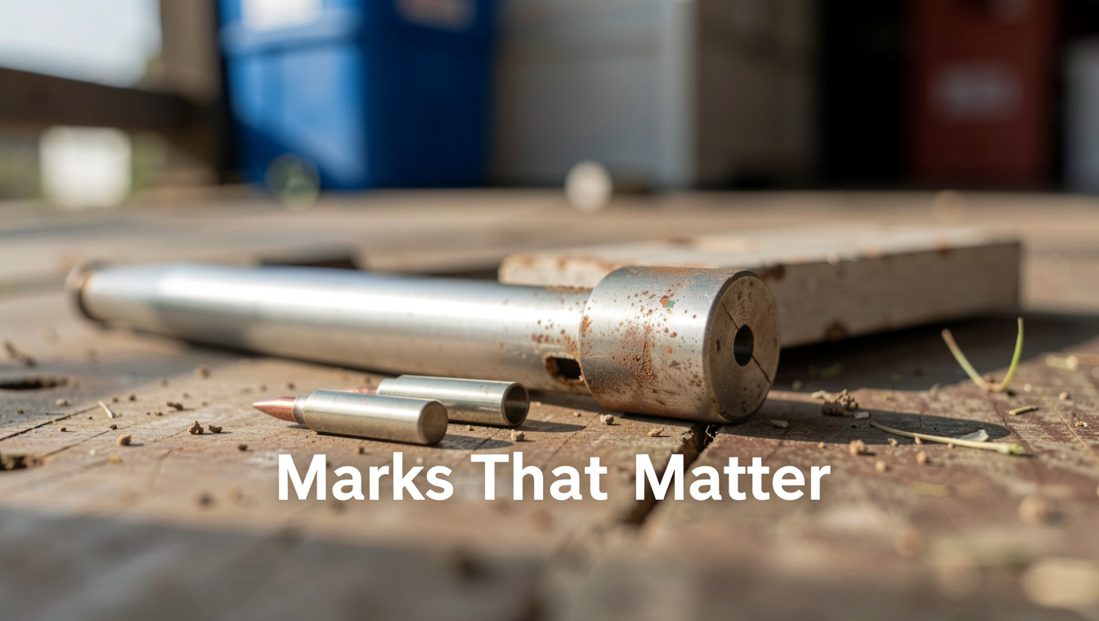
Every scored projectile sport solves two problems with the same mechanism: whose projectile is this, and is it legal. Archery solved both before the wrap existed, with cresting, the painted band at the tail that named the archer and, in some rulebooks, declared the equipment. The wrap inherited the job.
What the mark is for
Identification first, and the mark is older than the score. In a scored end, an arrow in the gold is a claim, and the claim stands on the mark that says whose arrow it is. Cresting did that job for a century of painted bands; the printed wrap does it faster, in more colors, and with the club's name in the bargain.
Regulation is the second job, and it is where the mark meets the rulebook. A projectile that must be legal is a projectile that must be inspected, and a marked projectile is a projectile that can be inspected cheaply. Archery's own rules of equipment are published by World Archery, and the same documented-control logic, applied to the Swiss crossbow, is kept at Swiss crossbow equipment rules.
How the check is documented
By a published rule and a named official, which is the machinery every projectile sport runs on. The rule states what is allowed; the official reads the mark against the rule; the mark makes the reading fast enough to be done between ends. The wrap is a better mark than the painted band in exactly one respect: it is printed, and a printed mark is the same on every arrow of a set.
The identification side of the same mark, at the level of a club rather than a federation, is the wrap's other job: the band that tells a club's arrows from a guest's, which the season-long version of is read in outfitting a school archery season.
How the mark survives the equipment rules
By being smaller than the things the rules regulate. A rulebook that limits shaft diameter or point weight has no quarrel with a band of film, and a mark that stays inside the rules is a mark that can do its job in any competition that matters. The wrap's thickness and mass are the numbers that keep it legal, and the desk reads them as regulation figures rather than as decoration.
Why a printed mark beats a painted one
Because a printed mark is identical on every arrow of a set, and an identical mark is a mark that cannot be argued with. A painted crest differs arrow to arrow by the width of a brushstroke, and a scorer who wants to dispute a painted band has a case to make. A printed band makes the same statement on every shaft, which is why the wrap replaced the paint job in every context where the mark is checked rather than admired.
| Job | What the mark carries | Who reads it |
|---|---|---|
| Identification | Whose arrow it is | The scorer, the archer, the club |
| Regulation | Whether the equipment is legal | The official, against the rulebook |
| Belonging | Which club, which set | Anyone at the butt |
What the wrap changed
The mark, not the law. A printed band is easier to produce than a painted one and carries more of it: the club name, the number, the flag. The design tradition the wraps inherited is read in the state design tradition, and the quieter geometric line beside it is in the hex line and colorways.
The desk's interest in the mark is documentary rather than sporting: a marked projectile is a projectile that left a record, and a record is the thing the register exists to read. The band of film on an arrow is the smallest such record there is, a printed statement of whose arrow and whose colors, and the machinery that reads it at a competition is the same machinery, in miniature, that reads a filing at an archive. Both ask whose it is and whether it is allowed, and both answer from a written rule rather than an opinion.
The register's own small version of the machinery is the dated entry: whose page, written when, against which rule. The projectile's mark and the register's date are the same invention at two scales, and the desk keeps both because a mark that cannot be checked is not a mark, and a record that cannot be checked is not a record.
That is the whole machinery, and it is older than the wrap by a century: a marked thing, a written rule, and an answer that does not depend on who is asking.
The film is a footnote to that machinery, but it is a useful one, because a mark that prints the same on every shaft is a mark the rulebook can actually read. The desk keeps the footnote and the machinery it belongs to.