The register
Film and Gauge: What the Wrap Is Made Of
The film is the product: its chemistry, its thickness and its weight decide everything the other dockets measure.

Before a wrap has a design, a cut or a seam, it is a sheet of plasticized vinyl film: printed on one face, coated with a pressure sensitive adhesive on the other, and carried on a release liner until the moment it is laid on a shaft. Every other page of this register is reading a consequence of that sheet. This docket reads the sheet.
What the film is made of
The material is polyvinyl chloride compound, softened with plasticizer until it can be made into a film thin enough to close around a tube and still carry a print. The plasticizer is what makes the film flexible rather than brittle, and it is also what moves the density of the compound from one batch to the next by a few percent, which matters to exactly one question in the register: what the film weighs.
On the adhesive face, the film carries an embossed channel pattern finer than the eye resolves. That pattern is the air release layer, and it is the reason a wrap can be laid on a tube by thumb pressure without trapping a bubble: the air under the film has a road out. The catalogue that traded on this domain named it on every product sheet the archive holds.
Two gauges, one shelf
The record names two thicknesses and sells one. The 2019 product sheets and the home page both put the wraps on 2 mil vinyl, and the same home page named 4 mil as the material of what it called conventional wraps, the bumper sticker stock that it claimed weighed twice as much. Nothing in the record divides the 49 product addresses of the catalogue by gauge, or by length, so the desk does not invent that division: one film, one gauge, cut to one template.
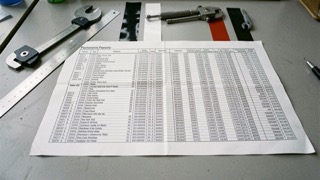
What the two figures are worth is arithmetic, and the register runs it rather than repeating it. A mil is a thousandth of an inch, so the two gauges are 50.8 and 101.6 micrometers, and at a stated area the mass of the film doubles between them. The desk follows that conversion in what a mil weighs, and keeps the result, with its inputs, in the spec table.
Cast, and the claim that travels with it
The 2019 sentence carried two words and one of them is a claim about manufacture. Cast film is made by spreading the compound as a liquid and drying it; calendered film is pressed between rollers. The two routes give different films, and the difference is visible at a bench without instruments: in how much light the film passes, in how its cut edge reads, in how far it stretches before it whitens, and in how it behaves on a curve. Cast against calendered vinyl reads the two routes and the four bench tests that separate them.
The weight half of the old sentence survives arithmetic intact, because doubling thickness at equal area doubles mass. The cast half is a statement about how the film was made, and an archive of pictures cannot confirm it. The register reports the claim as a claim, which is what editorial standards require.
Why the film comes first
Gauge is the first figure in the register because the other dockets inherit it. A longer band of a thicker film adds more mass at the tail, and mass at the tail is the whole subject of the balance docket. A film that conforms at room temperature takes a seam differently from one that wants warmth, and the seam is the subject of the length and cut docket. The same film gives up its grip under heat, and that is the application docket.
What was printed on the film is the last layer, and it is read in the patterns docket. The order of the register is the order of manufacture: film, cut, application, balance, and the design on top.
In this docket
The pages of this docket, newest first.
-

Film and gauge
Cast Against Calendered: The Two Films Behind a Wrap
Two films, one name. The way a vinyl sheet is made decides how it stretches, how it holds a print and how it ages on a shaft.
-

Film and gauge
What a Mil Weighs Once It Is on the Tube
A thousandth of an inch sounds like nothing. Wrapped twice around a tube, it becomes a mass the shaft can read.
-

Film and gauge
Reading a Spec Sheet Across Trades
A spec sheet is a claim with numbers attached. The numbers are only worth the method behind them, and the method is the part a seller would rather you skip.
-

Film and gauge
Buying a Roll by Mail: What the Listing Owes You
A listing is a promise made of fields. The ones that are filled tell you what you are buying; the ones left blank tell you who you are buying it from.
-

Film and gauge
What a Batch Code Remembers
A batch code is the smallest piece of documentation a roll carries: a run, a date, a machine. Read properly it is the difference between a material and a mystery.
-
Film and gauge
Reading a Class Rule as a Document
A one design class specification is a document with a scope and a date. The same reading discipline applies to a wrap specification sheet.
-