Length and cut
Cut Lines, Overlap and the Seam on the Tube
One rectangle, one seam. Where the cut falls and how much film rides over the edge decide how the wrap reads and what it weighs.
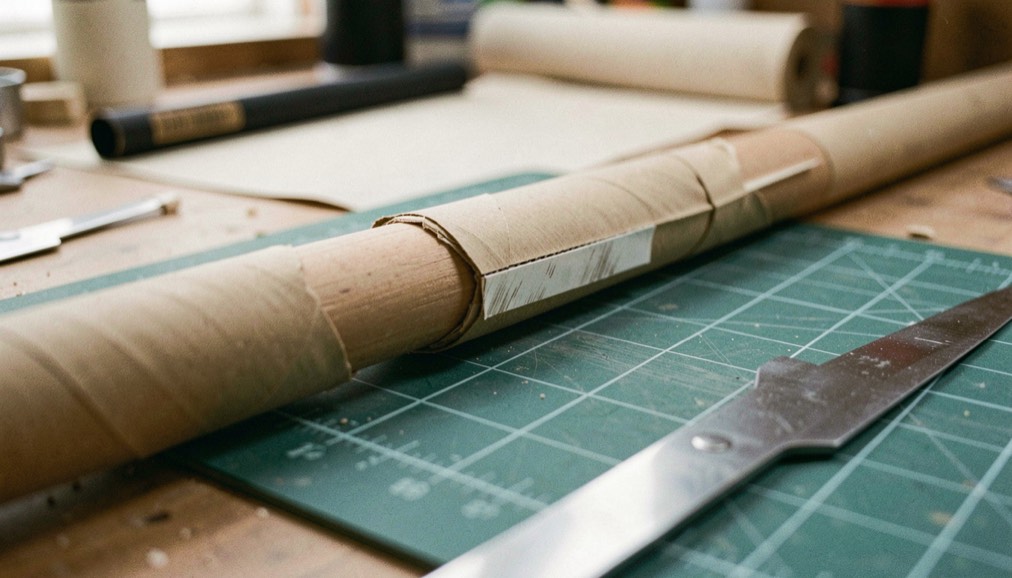
Whatever is printed on a wrap, the object itself is a rectangle of film with an adhesive face and a release liner. The rectangle has two long edges, and on the tube those two edges meet and cross: one lies down first, the other rides over it, and the line where they meet is the seam. Everything this page reads lives in that crossing.
One rectangle, one seam
The seam is not a flaw. It is the necessary consequence of wrapping a flat sheet around a closed curve, and every wrap on every shaft in every quiver has one. What varies is how much film crosses the joint, where the crossing sits, and how much the printed design does to hide it.
The archive is useful here in a small way. The product description captured from the 2019 catalogue said printed and cut arrow wraps, which states that the sheets arrived cut and not trimmed at home. The cut was part of what was bought, and therefore part of what a reader of the register has to imagine as a factory operation and not a kitchen one.
Where the cut falls
A rectangle has no natural starting point, so the cut line is chosen by the design. A field of a single color, or a figure that repeats, can be crossed anywhere and the seam shows as nothing more than a doubling of the film. A design with a central motif cannot be crossed at all: the cut has to fall in the quiet ground beside the motif, and the width of that quiet ground sets the limit of how much overlap the pattern can carry.
State designs are the demanding case, because a flag is a field and a seal is not. A design built on the field of a flag survives a cut almost anywhere in it; a design that carries a seal concentrates its detail in one place and leaves the rest of the rectangle to do the hiding. The desk reads the two families of the catalogue in the state design tradition and in the hex line and colorways, and the hexagonal patterns are the extreme of the forgiving case.
How much film closes the joint
The overlap is arithmetic before it is a preference. The strip has to be at least as wide as the circumference of the tube, which is the outside diameter multiplied by pi, and whatever the strip carries beyond that closes the joint. A tube 6 millimeters across has a circumference of about 19 millimeters, so a strip 25 millimeters wide leaves about 6 millimeters of film riding over the first edge on that tube. On a thicker tube the same strip closes with less to spare, and on a thinner one with more.
More overlap buys security: a longer bonded length resists an edge lifting at the seam, and it gives the adhesive a wider band to work in. It also adds a place where the film is doubled, which is where the wrap is visibly thicker and, on a light colored film, where the doubling reads as a slightly deeper line of color. The desk treats that as a trade to be stated rather than a fault to be corrected.
What the seam does to the print
Under the film, the seam is a step. Light catches it when it crosses the tube at an angle to the eye, and a seam that runs vertically down the cresting area is read differently from one that runs at a slant. Nothing in the manufacture removes the step; the choices available are where it sits, how long it is, and whether the design gives the eye something else to look at.
There is also a color question. Where the film crosses itself, the printed face is hidden under adhesive, so the doubled band shows the color of the back of the print through the film rather than the color of the front. On an opaque design the difference is invisible, and on a light film it is the reason a seam can read as a line even when the cut was clean.
Trim, and the weight of the offcut
Trimming a seam is a reflex worth questioning, and the arithmetic is worth running before the blade comes out. Six millimeters of width trimmed from a strip 100 millimeters long removes 6 square centimeters of film, which is about a quarter of a strip 25 millimeters wide. At 2 mil, in the compound assumed throughout the register, that offcut is about 0.04 grams, or roughly six tenths of a grain. On the arrow of added tail weight, six tenths of a grain removed from the cresting area moves the balance point by about one hundredth of an inch, which is a quarter of a change that was already below the resolution an archer selects. The mass question that a wrap genuinely raises is about the whole strip, and the desk follows it in what a mil weighs.
Trim is a seam decision, not a balance one. A trimmed seam is shorter and its edge is a cut edge rather than a factory edge, which is a fair trade on a shaft that will be handled and a poor one on a shaft that will be photographed. Before any of it matters, the tube has to be ready to take the film, and that preparation is the subject of surface preparation.