The register
Length and Cut: What the Wrap Covers
A wrap is a rectangle before it is a design: its length, its overlap and its trim are measured here.
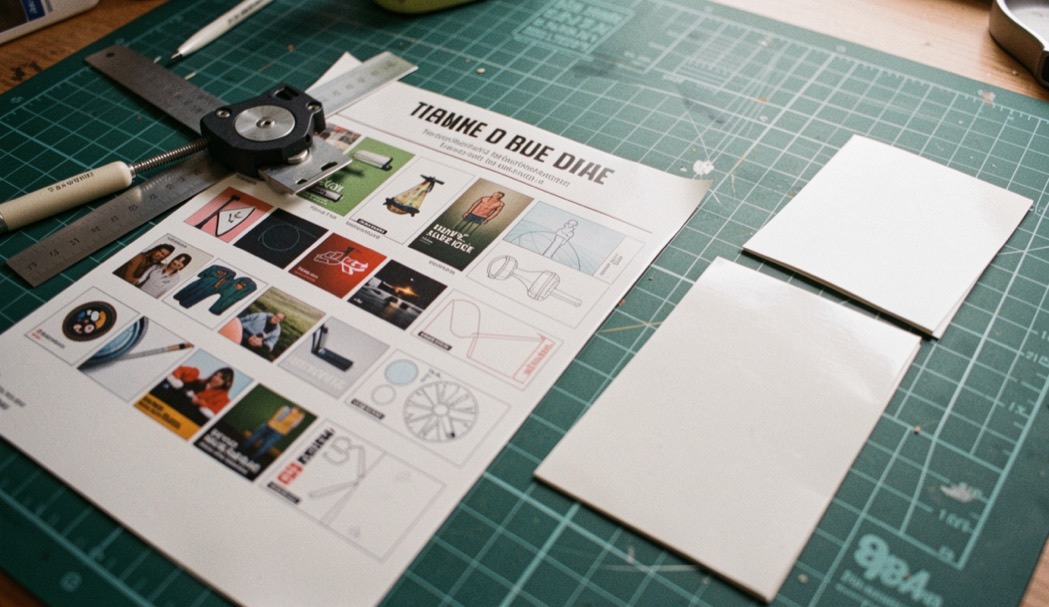
A wrap is a rectangle before it is anything else: a length of film, a width of film, two long edges and two short ones. The design printed on it does not change its geometry, and the geometry decides where the band sits on the shaft, how it closes, and how much of the tube stays bare.
The shape the shaft imposes
A shaft is a tube, and a tube has a circumference, so a strip has to be at least that wide to close. The circumference is the outside diameter multiplied by pi, and the register works it once on a stated tube rather than asserting a product dimension: a tube 6 millimeters across asks for about 19 millimeters of film, and a strip 25 millimeters wide closes on it with about 6 millimeters riding over the first edge. That surplus is the overlap, and it is the part of the strip a reader sees as a seam.
Length is a different decision. The tube has a parallel section in the middle and tapers toward both ends, and a band laid over a taper lifts or has to be trimmed to follow it. Wraps are cut for the parallel section, which is why shaft coverage reads the band as a length with a start and a stop, measured from the nock throat so that two arrows of a set can be compared.
Where the cut falls, and what it crosses
The 2019 catalogue described its goods as printed and cut wraps, which puts the cut in the factory and not on the kitchen table. Where the cut falls is a design question before it is a manufacturing one. A field of a single color, or a figure that repeats, can be crossed anywhere; a design that concentrates its detail in one place cannot be crossed there, and the quiet ground beside the detail sets how much overlap the pattern can carry.
The register reads both families of the catalogue with that constraint in mind. The state designs are the demanding case, because a flag is a field and a seal is not; the hexagonal line is the forgiving one, because a hexagon repeats without a direction. Both are read in the patterns docket, and the mechanics of the crossing, including what the doubled film does to the print and what a trim actually removes, are in cut lines and overlap.
What the rectangle weighs
A longer band is more film, and more film at the tail is mass where an arrow carries least of it. The arithmetic is short and the register runs it with its inputs named: at a stated area, a strip of 2 mil film is about 2.6 grains, and the same strip at 4 mil is about 5.1 grains. What those grains do behind the nock is the subject of the balance docket, and the conversion from thickness to mass is in what a mil weighs.
Trimming the overlap changes little of it. Six millimeters of width off a strip 100 millimeters long removes 6 square centimeters, which is about four hundredths of a gram at 2 mil, or six tenths of a grain. That is a quarter of the strip and a movement of the balance point of about one hundredth of an inch, which is why the register treats trim as a seam decision and not a balance one.
What this docket does not claim
The dimensions of the sheets the catalogue sold are not on the record, and the desk holds none of the film to read them from. The rows of the spec table say so plainly, and the geometry the register publishes is the geometry that arithmetic fixes: circumference, overlap, and the coverage a band of a given length can have on a tube of a given diameter.
In this docket
The pages of this docket, newest first.
-
Length and cut
Coverage: How Much of the Tube a Wrap Takes
A wrap is a band, not a coat. Where the band starts, where it stops, and what the bare tube does at both ends.
-

Length and cut
Cut Lines, Overlap and the Seam on the Tube
One rectangle, one seam. Where the cut falls and how much film rides over the edge decide how the wrap reads and what it weighs.
-

Length and cut
Measuring a Small Part Against Its Card
Small goods arrive with a card that says what they are. The card is a claim; the caliper is the check. Both belong on the bench.
-

Length and cut
A One-Day Plan for a Cutting Session
A cutting day is a production run, whether it makes twelve wraps or twelve hundred. Planned like one, it leaves a record; improvised, it leaves offcuts.
-

Length and cut
Where the Record of a Cut Lives
A defunct product leaves its record in pieces: an archived page here, a filing there, a catalogue sheet somewhere else. Knowing which office holds which document is the whole skill.
-

Length and cut
A Course Measured, Named and Photographed
The Isle of Man TT course runs 37.73 miles over closed public roads. A look at its named corners, Bray Hill, and what a wrap record keeps of a cut line.
-

Length and cut
Control Before Speed on a First Track Day
What a first track day teaches about control, entry angle and the moment to stop, and how a first cutting and wrapping session teaches the same lesson.
-

Length and cut
A Small Draw With No Money on the Line
How to run a small competition with no prize money: draws made before play, score sheets, written rules, and the same discipline as a cutting plan.
-