The register
Balance: The Weight Behind the Nock
A wrap is mass at the back of the tube. The desk reads where that mass sits and what it moves.
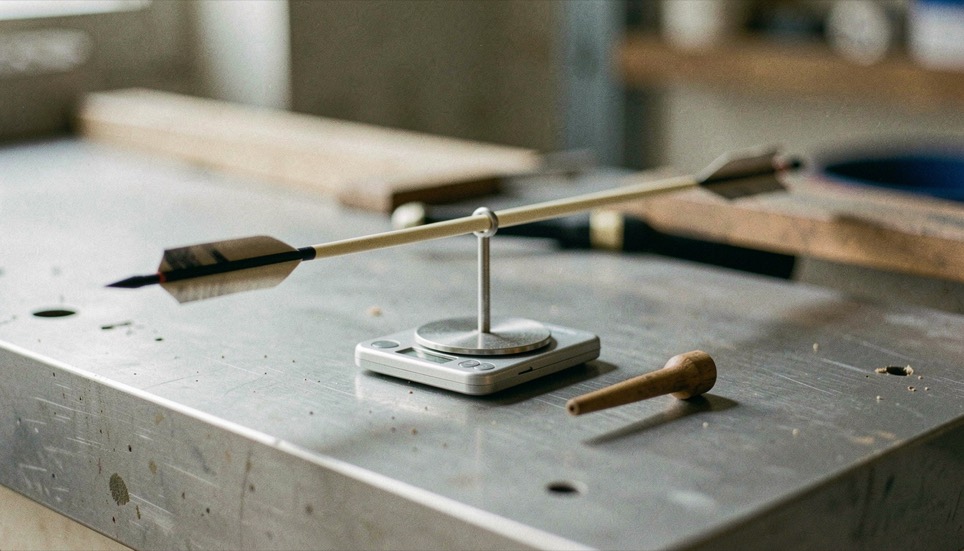
Archery tunes the mass at the front of an arrow in grains and ignores the back of it, because almost nothing is ever added there. A wrap is the exception: a few grams of film on the tube behind the nock, in the place the string pushes. This docket reads what that mass is, where it sits, and what the paper target can honestly say about it.
How much film weighs, and where it sits
The mass is arithmetic, and the register runs it with its inputs named rather than repeating a number without its conditions. On a stated strip of 100 by 25 millimeters, and a stated compound density of 1.3 grams per cubic centimeter, a 2 mil film is about 0.17 grams, or 2.6 grains, and a 4 mil film about twice that. What a mil weighs carries the conversion and the assumptions, and the spec table keeps the rows with their dates.
Position is the other half of the read. The band sits in the cresting area, behind the arrow's balance point, so its lever arm is most of the length of the shaft, and a small mass on a long arm moves the balance more than the same mass at the middle would.
The arithmetic, worked on a stated arrow
On an arrow of 350 grains and 28 inches whose balance point sits 16 inches forward of the nock, a 2 mil wrap in the cresting area moves the balance point rearward by about six hundredths of an inch and lowers the front of center by about two tenths of a percent. The 4 mil wrap doubles both. Added tail weight works the whole case and states plainly what the result is worth: a real direction, a real proportion, and a change below the resolution at which an archer selects front of center.
Spine is a different read and comes out unchanged. Spine is measured by deflecting a shaft with a weight at its middle, so a film on the tube adds nothing to the static figure. The dynamic reading, at launch, is another matter, and the comparison the register reaches for is the lighted nock: mass at the same end, several times heavier, that archers already accommodate by testing.
What the paper can carry
The honest test is a comparison shot in one session: the arrows bare, wrapped, and bare again, the third set being the one that says whether the difference belongs to the film. What the paper can report is where the group moved, whether its shape changed, and whether it repeats; what it cannot report at ordinary distances is a change of a few tenths of a percent read against an ordinary shooting error. Flight and groups sets out the order of the test and the variables that have to be held, and names the one that is most often missed: a wrap that sits under the fletching can mean a refletch, and a refletch changes flight more than the film does.
What this docket refuses to say
It refuses a verdict. Whether a wrap changes an arrow's flight enough to matter is a question the paper answers for one arrow, one bow and one archer, and the register describes the test rather than predicting the result. The arithmetic says how big the change can be; the shooting says whether it arrived; and the desk, which holds no film and no bow, publishes the first and the method for the second, which is what editorial standards allow it to publish.
In this docket
The pages of this docket, newest first.
-

Balance
The Wrap as Mass: What Sits Behind the Nock
The wrap is the only equipment that adds mass at the very back of the arrow. The desk reads where that mass sits and what it moves.
-
Balance
Reading Flight and Groups, Bare and Wrapped
Same bow, same arrows, one difference: the film. The desk describes how the test is run and what the paper can and cannot say.
-
Balance
Where a Shot Starts: Arrow Flight and Ball Flight
An arrow and a golf ball share a secret: the shot is decided in its first meters, and the rest of the flight is the first meters playing out.
-

Balance
Keeping a Measurement: Names, Dates and Files
A measurement that cannot be found again is not a measurement. The desk keeps its figures in named, dated files for exactly that reason.
-
Balance
What a Season Keeps: Tables, Magazines, Wraps
A league table, a club magazine and a wrap record each keep something different over a season. Here is what survives, and what it leaves out.
-
Balance
Judging a Run, Phase by Phase
A sheepdog trial scores each phase on its own line, and a wrap inspection checks each zone on its own line. Both put the number down before the next phase
-