Patterns
Hexagons and Colorways: The Line Without a State
Not every wrap names a state. The hexagonal line runs beside the flags, and its colorways test what the print can hold.
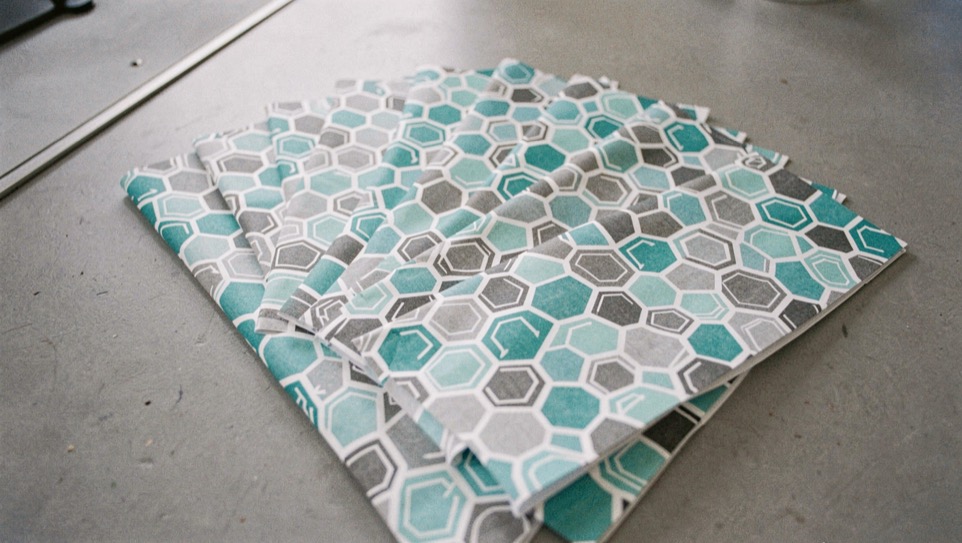
Beside the state designs, the catalogue kept a line of patterns that name no place. They are geometric: a hexagonal figure repeated across the width of the band, printed in a single color on a single ground. The desk reads them here because they are the cleanest object in the register, and what is clean is what shows how the rest works.
The line, as the record holds it
The archived addresses name the line plainly. There is a product called a hex wrap, a sample wrap, and a set of variants whose codes are a state abbreviation followed by a word: a hexagonal pattern in gray, another in turquoise, and plain color wraps in white, gold, blue, yellow and a dark green camouflage figure. The codes are read as they were printed. The desk reports what the codes say and does not guess at shades it has not seen, because a color named in a code is not a color on film.
Two things about the line are worth stating from the record. It shared the catalogue with thirty one state designs, and it shared the film with them: the same 2 mil vinyl, the same adhesive, the same pack of twelve printed and cut wraps. The hexagonal line was not a different product. It was the same product with the state taken out.
The catalogue also carried a custom wrap, which is the one address in the family that promised a design supplied rather than chosen. It belongs to this docket only by exclusion, since it is neither a state nor a hexagon, and the archive holds a title and a description of it rather than a picture. The desk records that it existed and stops there. What a supplied design would have asked of the film is the same question the state designs ask, and the state designs are the ones the record can actually read.
Why a hexagon is a forgiving figure
A hexagon repeats without a direction. It has no top, no left, no right, and no center, so it tiles a rectangle from any corner and it can be cut anywhere: two cut edges brought together on the tube still meet in pattern, because every edge of the figure is the same as every other. A state design concentrates its detail in one place and constrains the seam; a hexagon has no detail to concentrate and no constraint to respect.
That property makes the line useful beyond its look. A seam that falls inside a repeating figure is the shortest possible seam, and a pattern with no top can be applied by a printer without regard to which end of the strip goes on first. Cut lines and overlap describes what the crossing does to a print, and the hexagonal line is the case where the answer is: as little as possible.
What a colorway is, and what it changes
A colorway is one design printed in more than one color scheme, and the codes show the catalogue practicing it on both lines: the same figure in white, in blue, in yellow, in gold. What changes is not decoration but contrast. A pale band on a dark shaft is read across a room; the same figure in a dark green camouflage print on the same shaft is read from a hand's width. The choice of colorway is a decision about who is meant to see the band, and the two answers are both legitimate.
Contrast is also a printing question, and it is where the colorway meets the film. A white print carries over a dark ground with a body that a light gray print does not, and the finer the figure, the more the difference shows. The state design tradition is the other end of that spectrum, where the colors are named in law and the detail is a seal.
One more read belongs to the color and not to the film: what the band does in motion. A pale band on a dark shaft is read by the eye as the arrow turns and is easy to find again in a target butt, and a dark green camouflage figure is designed to be read as little as possible. Neither choice is a defect. They are answers to two different questions about who is meant to see the arrow, and the codes the catalogue carried are the record of a maker having stocked both.
Reading a colorway at the bench
Because the hexagonal line changes one thing at a time, it is the best place in the register to compare film behavior without a design getting in the way. Two wraps of the same figure in two colors are the same film, the same adhesive and the same cut, and any difference in how they read on a shaft is the color. The desk has none of the film and says so; the method is what it can offer, and the method holds whoever runs it.
The words used on this page, colorway, coverage, seam, air release, are given once and in the sense the desk uses them in the glossary, and the figures the register stands behind, each with its date, are in the spec table.