The register
Application: On the Shaft, and Off It
The adhesive does two jobs at once: it lets air out while the film goes on, and lets go again when heat is applied.
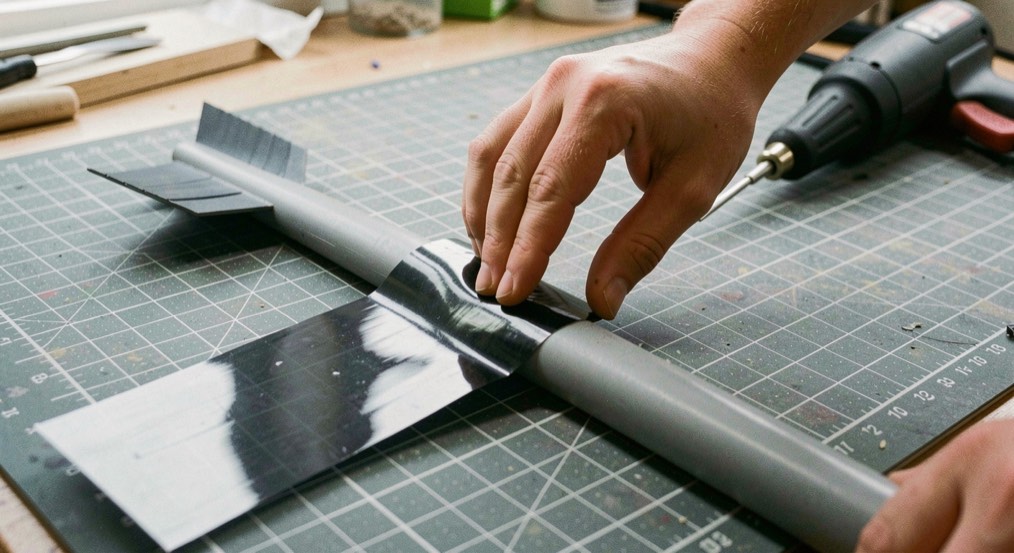
The adhesive is the part of a wrap nobody sees and the part that decides everything: it holds the film to the tube for a season, it lets the air out from under the film while it is being laid, and it gives the film up again when it is warmed. Two of those three jobs happen on the day the wrap goes on, and the third happens the day it comes off.
The tube before the film
A pressure sensitive adhesive bonds to a surface, not to whatever is lying on a surface, and a shaft out of a quiver is carrying skin oil, silicone from a polishing cloth or dust in a film thin enough to be invisible. Any of them becomes the layer the adhesive holds to, and the bond is then only as good as the layer. The air release layer makes the demand stricter, because its channels are finer than a particle of dust, and a channel that is blocked stops working in that place.
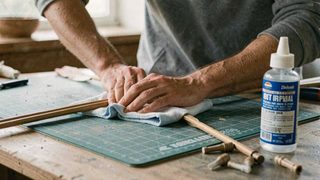
Preparation is short and it is ordered. Isopropyl alcohol on a lint free cloth, one pass in one direction, a fresh area of cloth for each shaft, and a wait long enough for the surface to be dry to a fingertip. Surface preparation carries the checklist and the reasons behind it, including why a circular wipe puts back what it lifted and why a cold tube takes a film badly.
Pressure, and the road out for the air
The film is laid from the seam edge along the tube, not around it, and pressed from the seam outward, so the air under it is pushed toward the channel pattern rather than trapped ahead of the pressing thumb. Where the air has a road out, no bubble forms; where it does not, no amount of pressure moves the bubble afterwards. The trick of the product is that the road is built into the adhesive face and not into the way it is applied, which is what lets a band of film go on without a squeegee.
What the film crosses on its way round the tube is the other half of the operation, and it is a geometry question: cut lines and overlap reads where the seam lands and what the doubled film does to the print.
Heat, and the way back
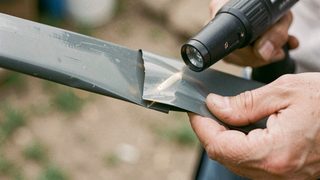
A pressure sensitive adhesive is a solid that flows, and warmth makes it flow readily. Warm the film, lift an edge at the seam, and pull the film back on itself at a low angle with the heat just ahead of the peel front: the band comes off in one piece and the tube is the tube that was prepared before the film went on. Removing a wrap with heat describes the temperature, the direction of the pull, and what the residue says about how the film was put on.
Removal has a cost the register counts rather than hides. A wrap that sits under the fletching takes the vanes with it when it goes, so refletching is part of the price of the film, and a wrap removed is a few grains taken off the tail of the arrow.
Why application is a docket
The film's behavior on the tube is a property of the film, and the register reads it as one. Whether it holds depends on the preparation and the adhesive; whether it comes off cleanly depends on the same two; and what it adds to the arrow while it is on depends on the gauge, which the balance docket reads and the spec table records with its inputs and its dates. The words of the bench, including air release and pressure sensitive, are given in the glossary.
In this docket
The pages of this docket, newest first.
-
Application
Before the Film: Preparing the Shaft
An air release adhesive cannot push a film onto dust. The shaft is prepared before anything else happens to it.
-
Application
Heat and the Second Half of the Adhesive Job
The adhesive that lets air out while the wrap goes on also lets go when it is warmed. Removal is the same film read backwards.
-

Application
What Weather and Water Do to an Adhesive
The adhesive was tested in a laboratory and lives in the weather. The gap between the two is the subject of this page.
-

Application
Preflighting a Wrap: The Checks Before the Film Goes On
A preflight is the five minutes of checking that makes the next hour uneventful. The wrap version is thirty seconds long and prevents every failure that is actually common.
-

Application
The First Month of a Wrapping Habit
A week by week look at what a shooter does in the first month on a new tube, and how a beginner running plan paces a new routine without turning it into a test.
-

Application
Reading a Site Before You Wrap It
A wrap desk documents a site the way a dive guide documents a dive: range, light, water, access, and the level each entry asks of you.
-
Application
Slow Teaching: A Beginner's First Wrap
A coach's slow progression for a child learning to swim, applied to a new archer's first arrow wrap and to the parent watching from the bank.
-

Application
A Commute That Survives the Weather
What riding to work five days a week teaches about consistency, kit and maintenance, and how a shaft wrap asks for the same discipline across a season.
-
Application
Reading a Break Before You Commit
What a surf school drills about a break and a tide, and what a wrap desk checks before a shaft goes on the bench. Two habits of reading conditions first.
-
Application
A First Karate Class and a First Wrap Session
What a beginner's karate class covers, from grades to dojo etiquette, and how a first arrow wrap session follows the same order of work.
-