Reference
The Spec Table
One table, one row per property, and the date each figure was last read. It is the page every docket cites.
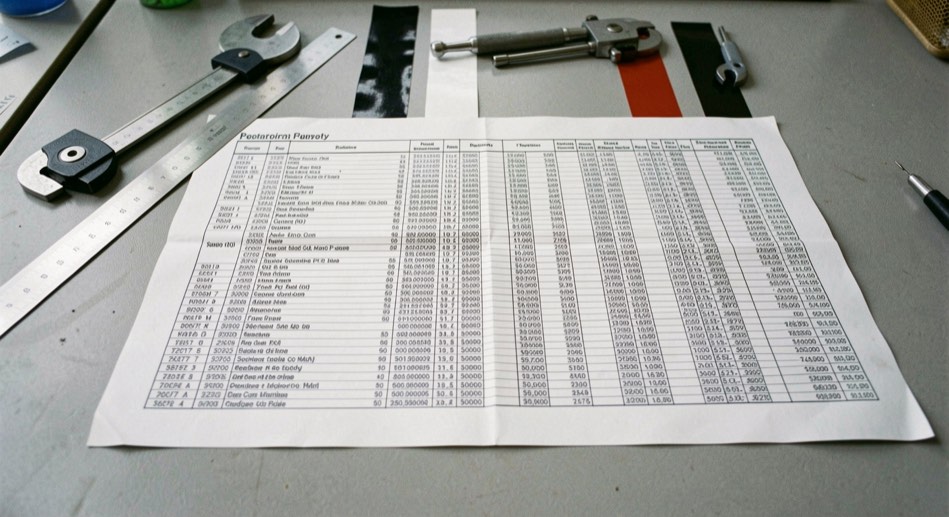
Every figure the desk publishes is in this table, and every figure carries two things besides itself: how it was obtained, and the date it was last read. The distinction between the two kinds of row is the discipline of the whole register. A definition is true by agreement. An arithmetic result is true relative to the inputs it names, and anyone who changes the inputs changes the result. A measurement would be true of the film in hand, and the desk holds none, so the table has none.
What a row is allowed to say
Three statuses appear in the last column. A definition row states a conversion the trade already agrees on, and it needs no source beyond the agreement. An arithmetic row states a result computed from inputs that are named in the row, usually in the page that derived it. A not read row states a property the desk has no way to read, because no film of the catalogue is in the drawer, and it says so instead of filling the cell with a plausible number.
The arithmetic rows are the ones most likely to be repeated without their conditions, which is why the conditions live in the same cell. A strip of 2 mil film is not 0.17 grams; a strip 100 millimeters long and 25 millimeters wide, in a compound of 1.3 grams per cubic centimeter, is about 0.17 grams. Both halves of that sentence travel together or not at all.
| Property | The figure | How it is obtained | Status and date |
|---|---|---|---|
| Gauge sold in the catalogue | 2 mil | Stated on the 2019 product sheets and home page | Archive, September 3, 2026 |
| Second gauge named | 4 mil | Named as the material of conventional wraps, never sold | Archive, September 3, 2026 |
| Thickness of 2 mil | 50.8 micrometers | Definition of the mil | Definition |
| Thickness of 4 mil | 101.6 micrometers | Definition of the mil | Definition |
| Density of the compound | About 1.3 g per cubic centimeter | Assumed, not measured; change it and the mass rows move | Assumption, August 26, 2026 |
| Mass of a strip, 100 by 25 mm, 2 mil | About 0.17 g, or 2.6 grains | Area times thickness times density | Arithmetic, August 26, 2026 |
| Mass of the same strip, 4 mil | About 0.33 g, or 5.1 grains | Same arithmetic, doubled thickness | Arithmetic, August 26, 2026 |
| Mass of a pack of 12 strips | About 2.0 g at 2 mil, 4.0 g at 4 mil | Multiplication of the strip figure | Arithmetic, August 26, 2026 |
| Circumference of a 6 mm tube | About 19 mm | Diameter times pi | Arithmetic, August 27, 2026 |
| Overlap of a 25 mm strip on that tube | About 6 mm | Strip width minus circumference | Arithmetic, August 20, 2026 |
| Mass of a 6 mm trim offcut, 2 mil | About 0.04 g, or 0.6 grains | Same arithmetic, on 6 square centimeters of trimmed area | Arithmetic, September 5, 2026 |
| Balance point shift, 350 grain arrow | About 0.06 in at 2 mil, 0.12 in at 4 mil | Lever arm arithmetic on a stated arrow | Arithmetic, August 12, 2026 |
| Front of center change | About 0.2 to 0.4 percent, rearward | Same arithmetic | Arithmetic, August 12, 2026 |
| Adhesive | Air release, pressure sensitive | Stated on the 2019 product sheets | Archive, September 3, 2026 |
| Strips in a pack | 12 | Stated on the 2019 product sheets | Archive, September 3, 2026 |
| Length and width of the 2019 sheets | Not read | The desk holds none of the film and no catalogue states them | Not read |
| Release temperature of the adhesive | Not read | No film in hand, no measurement on record | Not read |
How a row changes
A row does not change by being overwritten. The procedure is on editorial standards: the figure is challenged, the challenge is read, and if the figure stops holding a new one takes its place with a new date, the old one staying in the note that records the change. A row that cannot name its method is removed rather than repaired.
Rows that a reader can settle in a kitchen are the arithmetic ones, and the desk invites the recompute. Rows that need film, a scale and a controlled surface are the measurement ones, and a reader who holds the film can close the gap: the desk says how in write to the desk.
What the table is for
The table is the register's spine, and the dockets lean on it. The film docket reads the two gauges in what a mil weighs, the length docket reads the overlap in cut lines and overlap, and the balance docket reads the lever arm in added tail weight. The words the rows use are given in the glossary, and the desk that keeps the table honest is described in about the desk.