Application
Before the Film: Preparing the Shaft
An air release adhesive cannot push a film onto dust. The shaft is prepared before anything else happens to it.
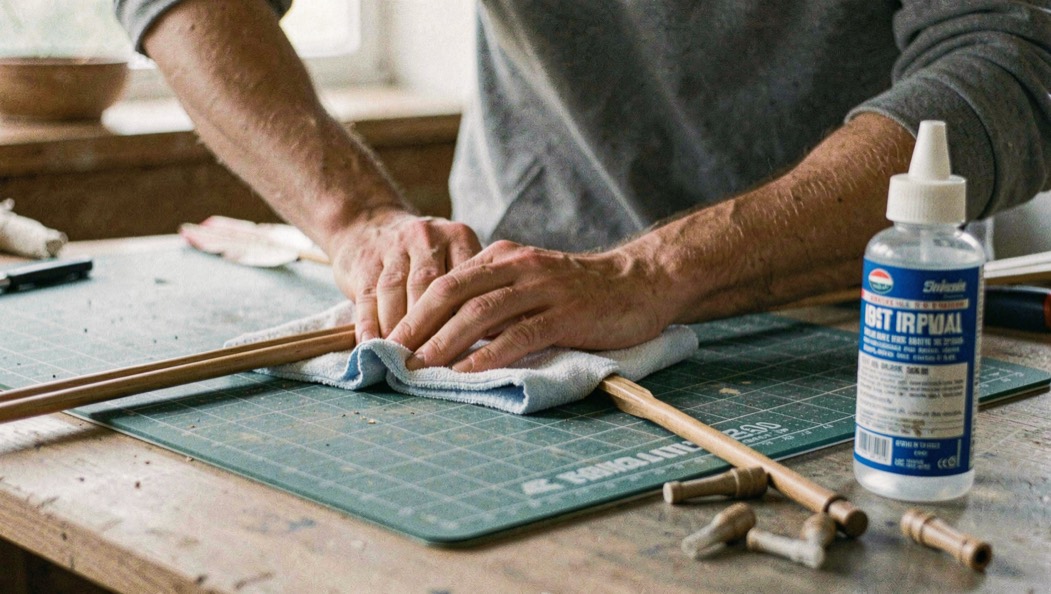
Everything that goes wrong with a wrap after it is on the tube can usually be traced to the tube before the film arrived on it. The adhesive is asked to hold a film of hair thickness against a tube that will be drawn from a quiver, wiped with a glove, pushed through brush and stood in a target. It holds or it does not, and the difference is made before the backing paper is peeled.
What the adhesive asks of the tube
A pressure sensitive adhesive bonds to a surface, not to whatever is lying on a surface. Fingerprints carry skin oil; a shaft that has been rubbed with a silicone cloth carries silicone; a shaft that has lived in a tube carries dust that is invisible until a finger passes over it. Any of them sits between adhesive and substrate, and the bond is then to the contaminant, which lets go.
The air release layer makes the demand stricter, not looser. The embossed pattern that lets air escape from under the film works in channels measured in hundredths of a millimeter, and a particle of dust that fills a channel stops it working in that place. The result is the familiar bubble that no amount of thumb pressure moves, because the air underneath has lost its way out.
Cleaning, and what a wipe leaves behind
The standard preparation is isopropyl alcohol on a lint free cloth. The details that matter are three. One pass in one direction, because a circular wipe picks up what it has just lifted and puts it back down. A fresh area of cloth for each shaft, because a cloth that has cleaned one tube is carrying its residue to the next. And a wait after the wipe, because the solvent has to leave the surface before the film arrives: adhesive applied over a wet surface bonds to the wet surface.
Water is the wrong solvent for this job. It lifts dust and leaves the oils, and it leaves a film of its own on a tube that is often a meter from the tap. Alcohol is cheap, it evaporates without residue, and it is aggressive enough to lift finger oil, which is the contaminant that matters most on a shaft that has been handled while being fletched.
Temperature, of the tube and of the room
Adhesive tack falls as temperature falls. A tube brought in from a cold vehicle is a cold tube, and a film pressed onto it at room temperature is a film whose adhesive is being asked to work below the temperature it was formulated for. The tube and the film should be at the temperature of the room they are being worked in, and the cheapest way to arrange that is time.
The other end of the scale matters less here than it does on a vehicle panel. A wrap is a band on a small radius, and the warmth that helps a calendered film lie down is the same warmth that is used later to take the film off. Removing a wrap with heat is the same relationship read in the other direction.
The order that holds
- Bare tube inspected: a shaft that is split, creased or nicked does not get a film over the damage.
- Finger contact ended: the tube is held by the ends or through a cloth from here on.
- Isopropyl alcohol on a lint free cloth, one pass, one direction.
- Dry end of the cloth, second pass, to lift what the solvent has loosened.
- A wait long enough for the surface to be dry to a fingertip.
- Film offered to the tube at the seam edge first, pressed down along the tube, not around it.
- Thumb pressure from the seam outward, so the air has somewhere to go.
Fletching, and the order of the whole job
Preparation belongs to a larger order, and the larger order is decided by the fletching. A wrap sits in the cresting area, which is where the base of a vane sits, so the film goes on before the vanes and not after them. On a bare shaft that is the natural sequence and it costs nothing. On a shaft that is already fletched it becomes a decision: either the band is cut to stop short of the vanes, which shortens the covered length and puts the seam in a shorter run of tube, or the vanes come off and go back on afterward, which is a refletch and the glue drying time that goes with it.
That order is also the reason the wipe is worth doing properly the first time. A wrap that sits under the fletching cannot be replaced without taking the vanes with it, as removing a wrap with heat describes, so a bond that fails after the arrow is fletched is not a five minute repair. The cost of a careless pass with the cloth is paid later, and it is paid in vanes rather than in film.
What preparation cannot fix
Preparation is not repair. A shaft with a split wall, a crease from a rosin-stained quiver or a nock seat that has been chewed by a mis-fitted nock will carry a film, and the film will hide the fault until the arrow is shot. Nothing on this page should be read as a reason to wrap a shaft that has failed inspection.
Preparation also does not survive handling. A tube cleaned and then gripped by a bare hand has been re-contaminated at the grip, so the order of the checklist above is not ceremonial: the cleaning is the step immediately before the film, not the step before lunch. Where the seam lands and how much film rides over the first edge, which is the other half of the application, is read in cut lines and overlap.