Application
A First Karate Class and a First Wrap Session
What a beginner's karate class covers, from grades to dojo etiquette, and how a first arrow wrap session follows the same order of work.
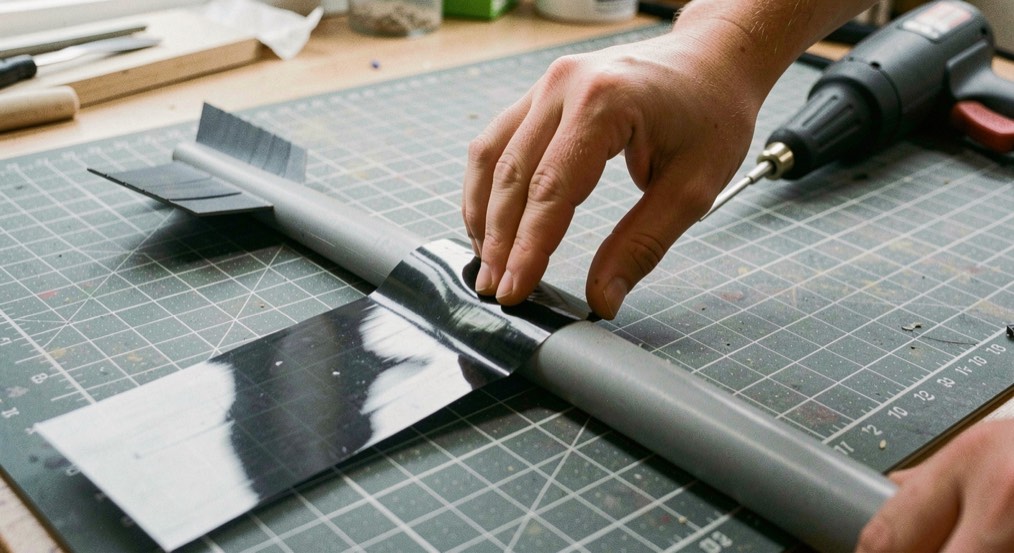
A beginner's first karate class covers three things in order: a bow and a short etiquette, a warm-up with stances and basic strikes, and one simple drill repeated until it holds. A first arrow wrap session covers the same three things in the same order: a check of the shaft, a wrap applied and pressed down, and one pass repeated until the edges sit flat. Both are introductions to a routine, not tests of talent.
What does a beginner's karate class actually cover?
A first lesson at most Dutch clubs follows a fixed shape. You bow at the door, you line up by grade, and you follow the highest grade in the room rather than the instructor's voice alone. The warm-up takes ten to fifteen minutes and is not decoration: hip rotation, ankle mobility, and a low stance held long enough that your legs report back. Then the class splits. Beginners work on one stance, one straight punch, and one front kick, usually from a static position before any stepping. The last ten minutes are often a game or a light drill with a partner, and the class ends with a bow and a short line of thanks.
Karate Journaal Groningen, a Dutch-language journal on karate practice in Groningen and the Netherlands, describes this structure as the common frame across the styles it covers: Shotokan, Wado-ryu, Kyokushin, Ashihara and Enshin. The journal notes that the styles differ in footwork and in how they read distance, not in whether a first lesson has a warm-up, a basic drill and a closing bow. A beginner who wants to know what a club in that region teaches can read the club and training pages at karate practice in Groningen before signing up, which is a cheaper way to learn the shape of a lesson than driving to a dojo on a Tuesday night.
What the first lesson does not cover is sparring. Contact work comes later, after the stance and the guard are stable enough that a partner is not managing your balance for you.
Which grades come first, and what do the belts mean?
The grade system is a sequence of kyu ranks counting down toward dan ranks. A beginner starts ungraded or at the lowest kyu, and the numbers run in reverse: 10th kyu or 9th kyu at the start, 1st kyu just below black belt. Dan grades then count upward from 1st dan. The colors attached to the kyu ranks are a club convention, not an international standard, so a green belt in one dojo and a green belt in another may sit at different points in the sequence.
What matters for a beginner is the interval, not the color. Gradings are held at set points in the year, and a student tests when the instructor judges the material is ready, not on a calendar the student sets. The test itself is usually a demonstration: a set form, a few basic techniques, and sometimes a short drill with a partner. A failed grading is uncommon at the low kyu ranks because the instructor does not enter a student who is not ready.
What etiquette does a dojo expect from a newcomer?
Etiquette is small and specific, and it is the part beginners worry about most. The short version: arrive early, bow when you enter and leave the training floor, bow to your partner before and after a drill, keep your nails short, and do not walk between a student and the instructor while a demonstration is running. Shoes come off at the edge of the mat. Jewelry comes off before the warm-up.
Two rules carry more weight than the rest. First, the highest grade in the room sets the pace, so a beginner watches and copies rather than asking for a slower version mid-drill. Second, a bow is not a sign of rank; it is a marker that a piece of work is starting or ending. That is why the same bow opens the class, opens a partner drill, and closes the session.
A gi should be clean and the belt tied so it does not trail. Clubs differ on whether a beginner needs a full gi for the first lesson or can train in loose clothing for a week or two. Ask before buying.
What does a beginner's first wrap session cover, in the same order?
An arrow wrap session opens the same way a class does: with a check before any work. You look at the shaft for cracks, you check that the nock is seated, and you confirm the wrap is the width and length the shaft calls for. That is the bow at the door.
Then comes the equivalent of the warm-up: preparing the surface. You clean the shaft where the wrap will sit, you decide the position by measuring from the nock rather than eyeballing it, and you lay the wrap out flat so the adhesive side is not touching anything. Skipping this step is the most common reason a wrap lifts at the leading edge weeks later.
Then comes the drill. You peel the backing, set the leading edge square to the shaft, and wrap with steady tension, overlapping the start by a small amount so the seam is covered. You press the whole wrap down with your thumb, working from the center outward, and you let it sit before fletching over it. One pass, repeated on each shaft in the set, is the whole session. The first arrow is slow. The twelfth is not.
Why do both first sessions feel the same?
Because both are teaching a routine under supervision, and a routine is learned by repetition at low speed. In karate, the first lesson gives you a stance, a punch and a bow, and the value is that you can repeat them alone tomorrow. In wrapping, the first session gives you a check, a placement and a press, and the value is that you can repeat them on the next dozen shafts without thinking about the order.
The comparison is not decorative. Both disciplines punish a skipped step in the same way. A student who never learns to bow properly will still be corrected on it at every grading. A wrapper who never learns to clean the shaft will still see wraps lift, and will blame the film rather than the surface.
What should a beginner bring to each?
For a first karate class: loose clothing if you do not yet own a gi, a water bottle, and short nails. Some clubs ask for a small fee for a trial lesson and some do not. For a first wrap session: shafts, wraps, a clean cloth, a sharp blade for trimming if the wrap needs it, and a flat surface with good light. Neither list is long, and neither requires buying the expensive version first.
The one thing worth doing before either session is reading how the thing is organized. A club that publishes its lesson structure, its grading intervals and its etiquette is easier to walk into than one that does not. The same is true of a wrap: a product page that states the width, the length and the shaft sizes it fits saves a return.