Application
Heat and the Second Half of the Adhesive Job
The adhesive that lets air out while the wrap goes on also lets go when it is warmed. Removal is the same film read backwards.
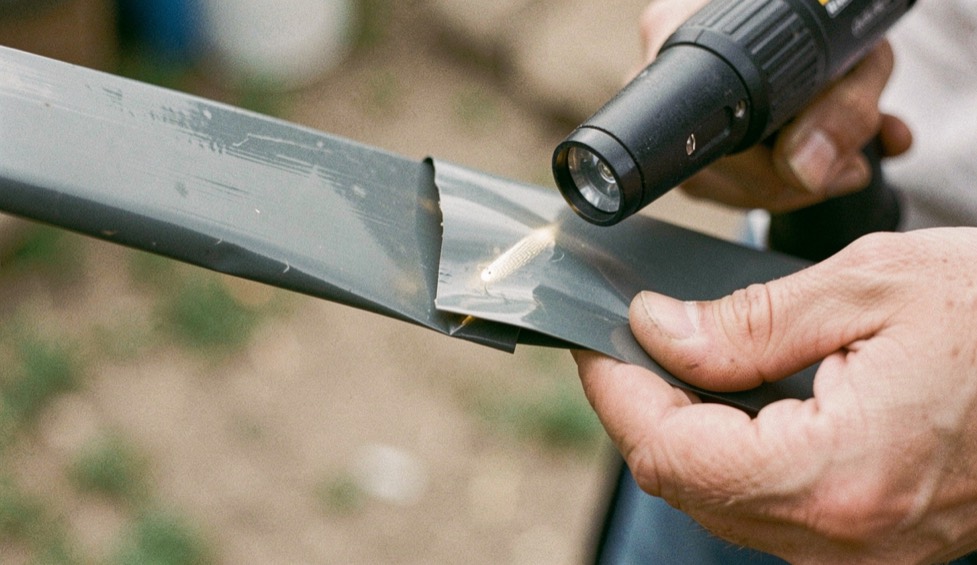
A wrap that could never come off would be a paint job, and paint has been on shafts for a century. The whole argument for a film over a shaft is that the film is a decision that can be reversed, and the reversal is not a solvent job or a scraping job. It is heat, applied to the same adhesive that let the film on in the first place.
Why the adhesive gives up
A pressure sensitive adhesive is a solid that flows. At room temperature it flows slowly enough to hold a film against a tube for a season of shooting; warmed, it flows readily, and the same property that let it wet the surface during application lets it release from the surface during removal. Nothing is dissolved and nothing is destroyed. The bond is softened until the film and the tube can be separated by hand.
The air release layer does no work at this stage and takes no harm from it. The embossed pattern is in the film side, the adhesive is on the other, and a film that has been warmed and peeled is a film whose release pattern is still on the released side if anyone cares to read it later.
How much heat, and where it goes
A hair dryer on a warm setting is enough for a band this small. A heat gun does the same work faster from a greater distance and punishes inattention proportionally, because the film reaches its softening point long before the tube reaches a temperature that matters, and the gap between those two moments is where a careless pass ruins a shaft's finish. The target is a film warm through to a fingertip, not a film that is hot.
The heat follows the work. Warming the whole band before starting to lift is time spent on film that is not yet coming off; warming a short span just ahead of the lifting edge puts the heat where the adhesive is being asked to let go, and moves along the tube with it.
Lifting, and the direction of the pull
The seam is where removal starts, because the seam is the one place where the film is doubled and an edge can be taken between two fingers without a blade. Once an edge is up, the film is pulled back on itself at a low angle, close to the tube, so the peel front stays narrow and the adhesive releases across a short line rather than across the whole width of the band.
A high pull angle does the opposite: it loads a wide front, the film whitens as it stretches, and it tears. A torn film is not a catastrophe on a shaft that is being stripped anyway, but it leaves the rest of the band bonded and the job becomes several small jobs instead of one. Low, slow and warm takes the band off in one piece, which is worth doing once for no better reason than to see that the film was one piece.
Residue, and what it says
Some adhesive stays behind, and where it stays is information. A line of residue along the seam says the film left by the seam, which is where it was expected to leave from. A residue that smears under a fingertip and rolls into beads is clean adhesive releasing as it should, and it comes off with the same alcohol used before the film went on. A residue that has hardened in place is adhesive that was overheated once, or adhesive that spent a season on a tube in a hot vehicle, and it takes solvent and patience rather than more heat.
The cleanest removals are on the tubes that were best prepared, which is not a coincidence. Adhesive that bonded to film contaminants at application releases from them rather than from the tube, and it leaves them where it found them. Surface preparation is the same page read at the other end of the film's life.
What the shaft looks like afterwards
Cleaned, the bare tube is the tube that was prepared before the film went on: same surface, same finish, same diameter. What has changed is small and worth naming. A wrap added mass at the tail of the arrow, and taking it off removes it again; the arithmetic of that mass, a few grains at 2 mil and a few more at 4 mil, is in what a mil weighs, and what a change at the tail does to flight is the subject of flight and groups.
The second change is to the fletching, and it is the reason removal is planned rather than improvised. A wrap that sits under the fletching holds the base of the vanes, and pulling the film takes the vanes with it. Refletching after removal is part of the cost of the film, and the desk counts it as such rather than as an accident.