Patterns
Outfitting a School Archery Season: Wraps, Colors and Lost Arrows
A school program owns fifty arrows and lends them out a hundred times a season. The wrap is how the equipment stays the school's and the scores stay the archer's.
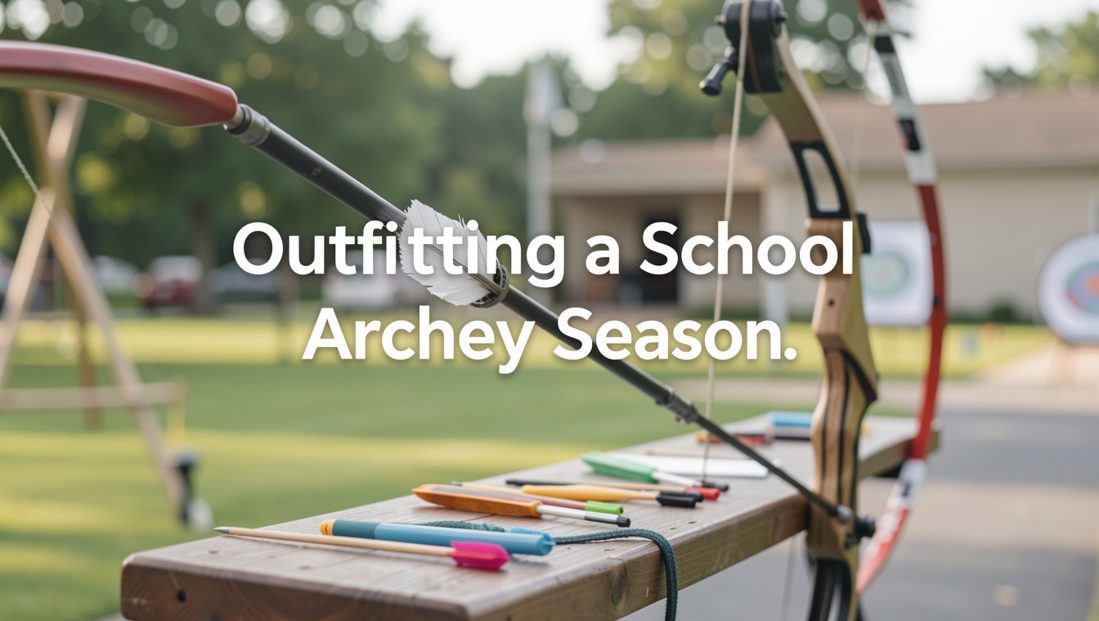
A school archery season is a small logistics problem wearing a sport's clothes. The school owns the arrows, the archers borrow them, and the equipment has to survive a semester of shared use and still be countable at the end. The wrap is the piece of that system that is visible: the band that says whose arrow it is, at the speed of a glance across a gym.
Why team arrows carry identification
Because shared equipment without identification is a pile, and shared equipment with it is a set. A wrap in the school colors does three jobs at once: it marks the school's arrows against a guest's, it marks the set against the stray, and it carries the number that ties an arrow to a line on the equipment log. The identification mark is the same job the scored end asks of a band, which marks that matter reads at federation scale.
How a school sports season is actually structured, the tryouts, the eligibility, the fees and the travel, is the subject of school sports season basics at The Activity Period. The sanctioning side of the same season, the rules under which the school competes, is kept by the National Federation of State High School Associations.
What the season does to the film
A season of gym use is harder on a wrap than a year of field shooting, because the arrows are handled by more hands and stood in more quivers than a personal set ever sees. The film that survives it is the film that was applied on a clean tube to begin with, which is the whole argument of surface preparation run at fleet scale.
The colors chosen are a quieter decision than they look. The school colors are the obvious choice and usually the right one, because identification wants contrast over novelty: a band that is read instantly at thirty meters is a band that has done its job. The read of what a colorway does to legibility is in the hex line and colorways.
What the equipment log keeps
One line per arrow: the wrap number, the set it belongs to, and the date it went into service. The log is the difference between a school that knows it lost three arrows in October and a school that knows it has a box. The desk's own version of that record-keeping is the batch log of what a batch code remembers, run at the scale of a single program.
What the wrap costs the program
Less than the lost arrows do, which is the arithmetic the decision actually runs on. A season of wraps for a school set costs less than one replacement dozen, and the number the log reads at the end of the season is the number that makes the case. A program that counts its arrows in October and March knows what the band saved, and a program that does not count is guessing.
The record that makes the arithmetic possible is the equipment log itself, which is why the desk's habit of dated lines is the same habit at the scale of a gym full of arrows.
| Job | Read by | Pays off when |
|---|---|---|
| School against guest | Anyone at the line | Every borrowed session |
| Set against stray | The coach at the end of the day | Every lost arrow |
| Number to log line | Whoever keeps the book | The end-of-season count |
What this page does not cover
The sport side of the season, the form and the scoring, which the school and its federation already document. This page is the equipment half: the band of film that keeps a shared set a set.
The wrap's season ends where the program's does, at the count in March, and the count is the figure the whole arrangement exists to improve. A school that runs the band and the log together keeps its arrows; a school that runs the band alone keeps its colors; and the difference between the two is the difference between an identification system and a decoration, which is the same difference the register keeps finding between a record and a description of one.
The season is the unit that makes the system legible: it has a beginning the wrap is applied in, a middle the log is kept through, and an end the count is read at. A program that runs all three knows what the band did; a program that skips the log has colors on arrows and nothing to show for it at the count.
That is the band's job description for a school program, stated plainly: keep the school's arrows the school's, keep the scores the archer's, and make the count in March a number rather than a guess.