Application
Slow Teaching: A Beginner's First Wrap
A coach's slow progression for a child learning to swim, applied to a new archer's first arrow wrap and to the parent watching from the bank.
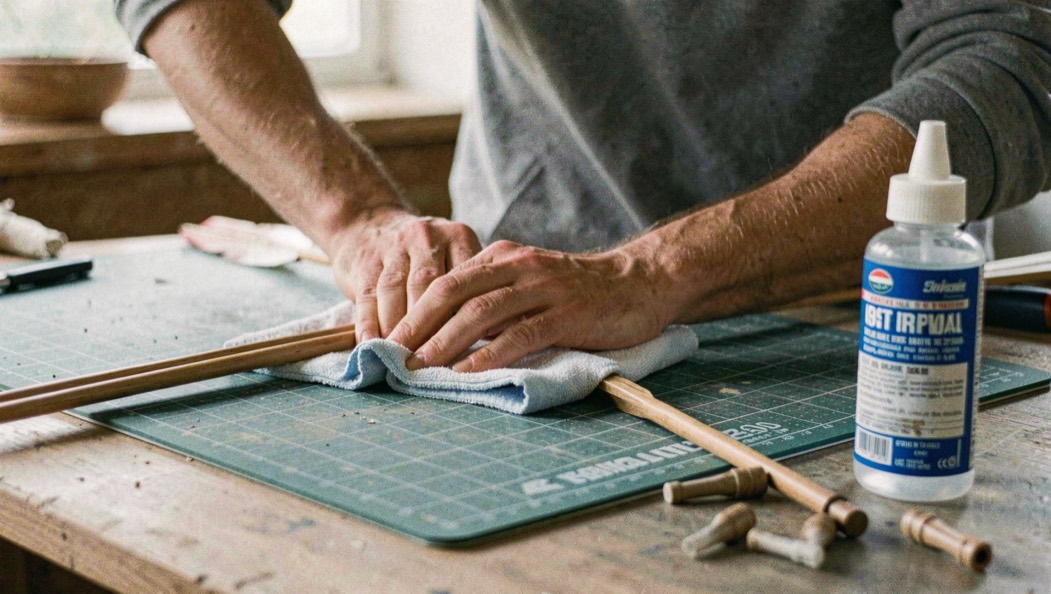
You teach a child to swim without pressure by breaking the skill into steps small enough that none of them can be failed, and by letting the child set the pace between them. The same logic holds when a new archer puts a first wrap on a shaft, and it holds for the parent standing at the poolside or the range fence, whose main job is to stay calm and stay quiet. Pressure is not the same thing as difficulty. A step can be hard and still be safe; what makes a beginner quit is a step that arrives before the one under it is solid.
How do you teach a child to swim without pressure?
A coach working with a nervous beginner rarely starts in the water. The first sessions are about the face, the ears, and the breath: blowing bubbles at the wall, putting one cheek in, then the chin, then the whole face, each one repeated until it is boring. Boring is the goal. A skill that has become boring is a skill the child owns.
The progression usually runs through five stages, and a coach will spend weeks on any one of them without apology. First, comfort at the edge: sitting, splashing, getting the face wet on purpose. Second, breath control: blowing out under water, breathing in above it, on a count the child can hear. Third, floating with support, then floating with a hand nearby but not touching. Fourth, a glide with the face in and the arms forward. Fifth, the first strokes, added one at a time rather than as a package.
What the coach is watching for is not speed but recovery. A child who surfaces from a face-in glide and smiles has banked the step. A child who surfaces and looks for the door has not, and the answer is to go back one stage, not forward. Parents who want to read how this is handled in one part of Scotland, and how clubs and adult learners fit around it, can find a working example in the coverage of how children and adults teach a child to swim across Fife, where the same staged approach appears in club sessions and in adult beginner courses.
What is the difference between front crawl and breaststroke?
The short answer is that front crawl is a continuous alternating stroke swum face-down with a flutter kick, and breaststroke is a symmetrical stroke swum face-down with a whip kick and a glide between pulls. The difference matters to a beginner because the two strokes ask for opposite habits.
Front crawl asks the swimmer to keep moving. The arms alternate, the legs flutter from the hip, and the head turns to the side to breathe rather than lifting. The hard part for a learner is the breath, because it has to happen inside the rotation of the body, not as a separate pause. Coaches often teach it with a kickboard and one arm at a time, then join the arms once the breathing rhythm survives.
Breaststroke asks the swimmer to pause. The arms sweep out and back, the legs perform a whip kick, and there is a moment of glide with the body long and the face in the water. The hard part here is timing, because the pull, the breath, and the kick have to arrive in the right order. A learner who rushes breaststroke will swim it as a struggle; a learner who waits will find the glide does most of the work.
Neither stroke is the beginner's stroke. A coach picks whichever the swimmer's body seems to accept first, and the other follows later. The same is true of the wrap on a shaft: there is a wrap that suits a new archer's hands and a wrap that does not, and the choice is made by trying, not by ranking.
How do children and adults learn to swim in Fife?
In Fife, the route usually starts with lessons at a local pool, moves into a club session when the swimmer can manage a length unaided, and continues either into competition or into recreational and masters swimming. The structure is not one ladder. It is several, and a swimmer can step sideways between them without losing anything.
For children, the common path is school lessons, then a learn-to-swim scheme at a council pool, then a club trial. Clubs in the region run squads by ability rather than age, and a child may spend a year in a development squad before a gala entry is considered. For adults, the path is often shorter and more private: adult beginner courses, one-to-one lessons, or a masters session where the pace is set by the swimmer rather than the lane.
What both groups share is the arithmetic of practice. A weekly lesson plus one other water session will move a beginner faster than two lessons and nothing else, because the second session is where the lesson is digested. Coaches say this constantly and it is still the most common thing families get wrong.
What a first wrap has in common with a first length
A new archer facing a bare shaft is in the same position as a child facing a lane. The task looks like one thing and is actually several, and the several have an order.
A sensible first wrap goes on in stages. The shaft is cleaned and the old residue removed, because a wrap will not sit on a dirty surface. The wrap is laid out and checked for the correct end. It is applied from one end with steady tension, not pulled tight and then adjusted. The overlap is kept even. The finished wrap is pressed down, and the ends are trimmed or tucked according to the wrap's own instructions. None of these steps is difficult. All of them can be rushed, and rushing is what produces the wrinkle that costs a dozen arrows later.
The coach's rule from the pool applies directly: do not add the next step until the current one is boring. A first wrap that goes on slowly and slightly crooked teaches more than a first wrap that goes on fast and has to be stripped.
What the parent is actually doing
The parent at the poolside and the parent at the range fence have the same job, and it is smaller than most of them expect. The job is to be present, to be unimpressed by setbacks, and to say almost nothing during the attempt.
A child learning to swim reads the adult's face before the coach's instruction. If the adult winces at a mouthful of water, the child learns that water is a thing to be feared. If the adult looks at a phone, the child learns that the attempt is not worth watching. The useful parent watches quietly, saves comment for the car, and leads with the step that was completed rather than the one that was not.
The same holds at the range. A parent who corrects every arrow during the first dozen will produce an archer who checks with the parent before every shot. A parent who waits until the end of the end, and then asks what the archer noticed, produces an archer who learns to read their own results.
Why slow progression survives contact with real beginners
Slow progression is not a soft method. It is the method that survives the first bad day, because it has somewhere to retreat to. A beginner taught in one leap has only two states, success and failure. A beginner taught in stages has a ladder, and a ladder can be climbed again after a fall.
This is why the staged approach appears in swimming instruction, in archery coaching, and in most skill teaching that has been tested over time. The steps differ by sport. The principle does not. Keep the next step small, keep the pressure low, and let the beginner arrive at the hard part already standing on something solid.