Balance
The Wrap as Mass: What Sits Behind the Nock
The wrap is the only equipment that adds mass at the very back of the arrow. The desk reads where that mass sits and what it moves.
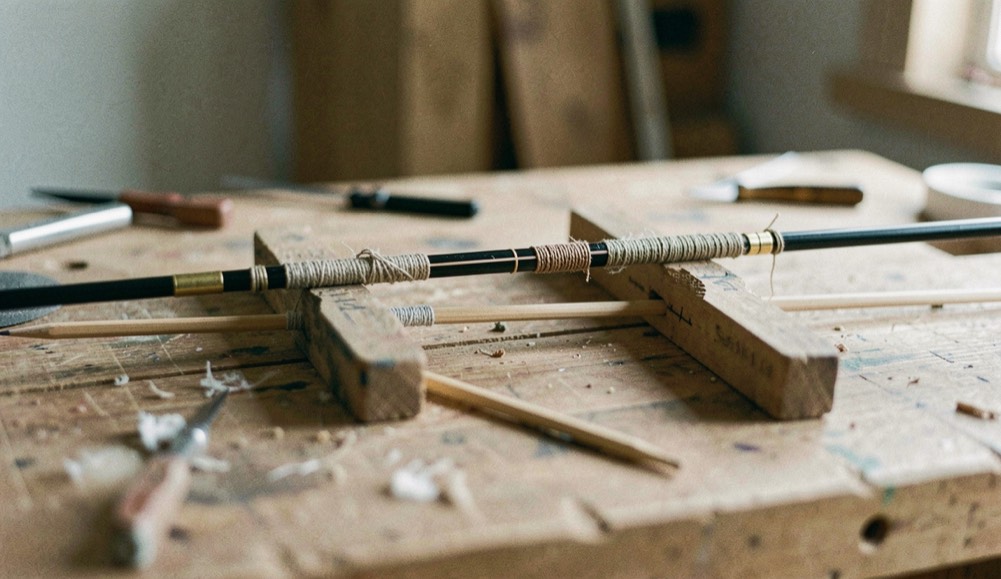
Archery adds mass at the front of an arrow habitually and at the back almost never. Points, inserts and outserts are chosen in grams; the nock is chosen to weigh as little as the maker can arrange. The wrap is the one accessory that puts mass at the tail on purpose, which makes it the only piece of equipment whose effect on balance runs in the direction nobody tunes for.
Where the mass sits, and why that matters
A change of mass is read through its lever arm. Two and a half grams at the point end of an arrow and two and a half grams at the tail do not do the same thing, because the tail is a long way from the arrow's balance point and the point is a long way in the other direction. A wrap sits in the cresting area, behind the balance point and in front of the fletching, so its lever arm is the distance from the balance point back to the band, and that distance is most of the length of the shaft.
The mass itself is small. The arithmetic in what a mil weighs puts a strip of 2 mil film covering 25 square centimeters at about 2.6 grains, and the same strip at 4 mil at about 5.1 grains, on assumptions that are stated there and can be changed there. The question on this page is what a few grains at the end of a long lever arm do.
The arithmetic, worked once
Take an arrow of 350 grains and 28 inches whose balance point sits 16 inches forward of the nock throat. The midpoint of the arrow is at 14 inches, so the arrow carries a front of center of about 7.1 percent, which is an ordinary figure. Add a wrap of 2.6 grains in the cresting area, 8 inches back from the nock, which is 8 inches behind the balance point.
The balance point moves rearward by the added mass multiplied by its lever arm, divided by the new total mass: 2.6 times 8, divided by 352.6, which is a little under 0.06 inches. The front of center falls from about 7.1 percent to about 6.9 percent. Run the same arrow with a 4 mil wrap and the shift doubles, to about 0.12 inches and a fall of four tenths of a percent.
| Read | Bare arrow | 2 mil wrap | 4 mil wrap |
|---|---|---|---|
| Mass added at the tail | None | About 2.6 grains | About 5.1 grains |
| Lever arm behind the balance point | None | About 8 inches | About 8 inches |
| Balance point moves rearward | Not applicable | About 0.06 inches | About 0.12 inches |
| Front of center | About 7.1 percent | About 6.9 percent | About 6.7 percent |
What the shift is worth
Front of center is chosen in whole percentages, and a shift of two to four tenths of one percent is below the resolution at which an archer selects it. That is the honest reading of the table, and the desk prefers it to the more dramatic one. What the table does establish is direction and proportion: the shift is always rearward, it doubles between the two gauges, and it scales with the area of film on the tube, so a longer band moves more than a short one.
It also establishes that the change is real arithmetic and not a story. A figure that can be recomputed from its stated inputs is a figure that can be argued with, which is the only kind the desk publishes.
Spine, and the direction of the reading
Spine is measured by supporting a shaft at two points and hanging a weight at the middle, so a wrap adds nothing to the static figure and no re-spining is implied by putting a film on a tube. The dynamic reading is different. Mass at the tail has to be accelerated with the rest of the arrow at launch, and mass that resists acceleration at the nock end changes the way the shaft bends in the first inches of the shot.
The comparison the desk reaches for is the lighted nock, which is the one mass at the same end that archers already accommodate. A lighted nock weighs several times what a wrap does, and the practice around it, testing after fitting and adjusting if the flight has changed, is the practice the desk suggests for a film. Whether the change reaches the paper is a question the paper has to answer, and flight and groups describes how to ask it. The figures behind this page, with their dates, are kept in the spec table.