Balance
Reading Flight and Groups, Bare and Wrapped
Same bow, same arrows, one difference: the film. The desk describes how the test is run and what the paper can and cannot say.
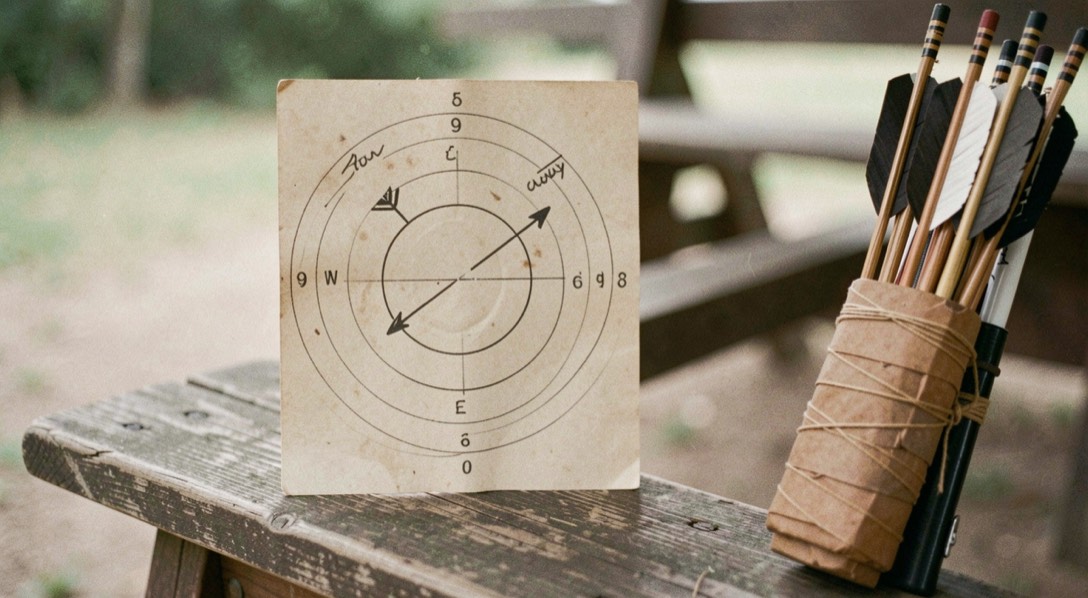
A group on paper is the record of everything that happened to the arrow between the string and the butt: the release, the rest, the wind, the light, the archer's hands and the archer's patience. A wrap changes one input, and a small one. The task is to run a test in which that small input is the only thing that moves, and then to read the paper without claiming more than it can carry.
What paper can and cannot say
At the distances where wraps are usually seen, the arithmetic of added tail weight predicts a shift of a few hundredths of an inch in the balance point and a change of a few tenths of a percent in front of center. No target at twenty meters resolves a change of that size against an ordinary shooting error, and the desk has no interest in pretending otherwise. What the paper can report is a comparison between two conditions shot in the same session: whether the wrapped group sits where the bare group sat, whether its shape has changed, and whether the change repeats.
That is a narrower claim than most writing about equipment makes, and it is the only one the evidence supports. A test that cannot repeat its own result has not produced one.
The order of the test
Three ends of arrows, three states. Shoot the arrows bare first, wrapped second, and bare again at the end of the session. The third set is the one most often left out and the one that carries the conclusion: if the arrows return to their first group when the film is off, the difference between the first two groups belongs to the film, or at least to something that left with it. If the arrows do not return, something else moved during the session, and the archer is the most likely candidate.
Ends are shot in the same order within each set, and the same arrows are used throughout. An arrow that sits out one set is an arrow whose results have to be thrown away, which is a cost avoided by numbering the set before the first shot.
Holding the variables down
The film is not the only thing that changes when a wrap goes on, and the honest test names the others. Fletching is the large one: a wrap sits in the cresting area and often under the base of the vanes, so fitting a wrap can mean removing and replacing fletching, and replaced fletching changes flight by more than the film does. An arrow that has been refletched for the test is testing the fletching.
Nocks come next. A nock that has been pulled to fit a wrap under it, or a nock replaced with a lighted one at the same time as the film, has introduced a change at exactly the end the film is changing. The desk's rule is one variable per session, and a wrap that arrives with new nocks is two variables.
What to hold constant
- The same arrows, numbered, in all three sets.
- The same nocks, unremoved, for the whole session.
- The same distance, the same face and the same butt.
- The same time of day, or at least the same wind record.
- Fletching untouched: if the film forces a refletch, the test is postponed until the new fletching has settled.
Reading the shape of a group
Three reads on the paper, in this order. Where the group sits relative to the bare group, which is a question of point of impact and answers to the balance change. Whether the group has spread, which is a question of consistency and answers to the way the shaft bends at launch. And whether any of it repeats in the third set, which is the read that decides whether the first two mean anything.
A wrap that leaves the group where it was and the shape as it was is not a failed test. It is the expected result at the sizes involved, stated in the terms the desk uses, and it is worth having on record precisely because so much of what is written about equipment assumes otherwise.
When the change is worth acting on
Act when the third set confirms what the second set suggested, and act in the direction the arithmetic points: if the impact has moved, the balance point has moved with it, and the correction is at the front of the arrow, not at the film. A wrap removed is a few grains taken off the tail, and removing a wrap with heat is how that is done without a solvent.
The desk keeps the figures that go into this test, the assumptions behind them and the dates they were read, in the spec table. Everything else on the paper belongs to the archer.