Balance
Where a Shot Starts: Arrow Flight and Ball Flight
An arrow and a golf ball share a secret: the shot is decided in its first meters, and the rest of the flight is the first meters playing out.
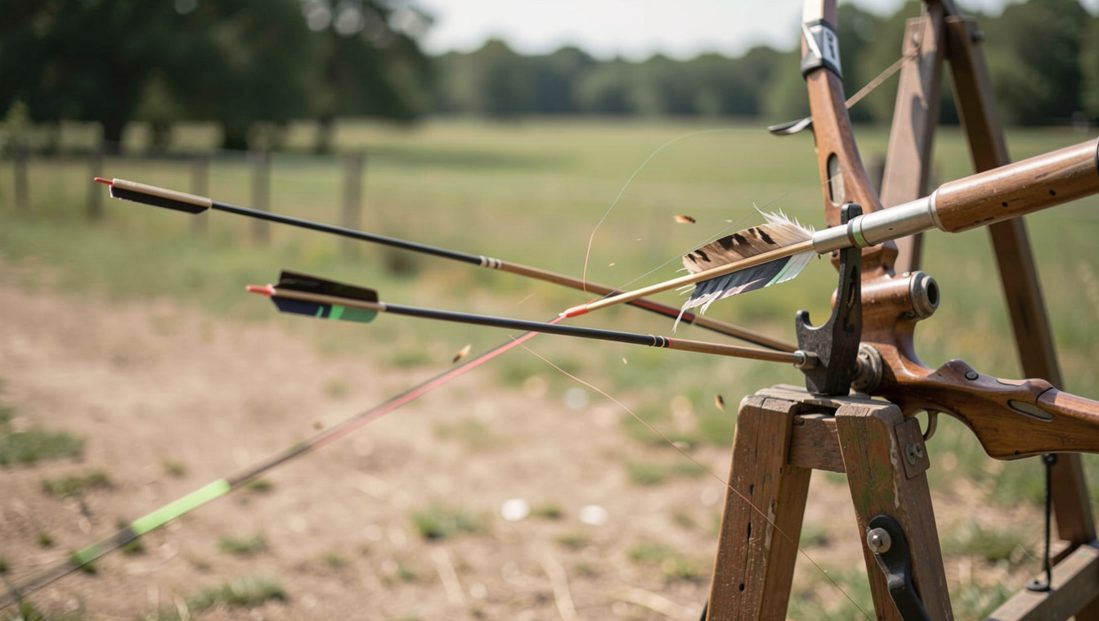
An archer watches an arrow leave and reads the first foot of it: the flex, the clearance, the moment the shaft stops being a launched object and becomes a flying one. A golfer reads the same first foot off the club face. Two sports, one mechanism: the conditions at launch decide the flight, and the flight is mostly the launch continuing.
What the launch actually carries
For an arrow, the launch carries the spine: how much the shaft flexes around the bow, and how it recovers. For a ball, the launch carries the face and the path: where the club face pointed and which way the club was moving. In both cases the first meters are not the beginning of the flight but its whole argument, because everything after is the initial conditions meeting physics.
The wrap sits inside that argument quietly: a few grains of film at the tail, where the shaft is recovering from its first flex. What those grains do to the recovery is small, and the desk measures it in added tail weight rather than asserting it.
What the two flights share
The law that the launch decides the flight, and the habit of reading the start before the finish. An archer who watches where the arrow lands before watching how it left has the analysis backwards; a golfer who watches the ball land before asking what the face was doing has the same problem. The mechanism of the golf half, face and path translated for an archer, is laid out in the nine ball flights at Hail Ridge Golf, and the aerodynamics underneath both flights are the kind the NASA Glenn pages on flight write for a lay reader.
Why the start matters more than the middle
Because the middle of a flight is only the start continuing. An arrow that clears the bow badly cannot recover into a better flight; a ball that leaves at the wrong launch cannot steer itself straight. The equipment changes that actually move a result are the ones that change the launch, which is why the register reads a wrap by what it does at the tail of the tube rather than by what it looks like at fifty meters.
The read of the result, at the paper, is the next question and the one the register is honest about: flight and groups asks what a target can truthfully report about a few grains of film.
What the wrap adds to the launch
A few grains at the tail, which is the least and the most honest answer the register can give. The mass is real, the position is real, and the effect is small enough that the desk will not claim a group tightened because of a film. What the wrap changes at launch is the balance point and a small shift in where the shaft's weight sits while it recovers, and both are measurable at the bench even where they are not visible at the target.
The reader who wants the target's side of the question, rather than the launch's, is reading the right docket: the flight the arrow makes after the launch is where the wrap's decoration does its real work, which is telling the archer which arrow is his at the butt.
| At launch | Arrow | Ball |
|---|---|---|
| What decides the flight | Spine, clearance, tail mass | Face angle, path, strike |
| What the first meters show | Flex and recovery | Starting line and curvature |
| What the landing reports | The launch, delayed | The launch, delayed |
What the comparison is for
It is for the habit, not the verdict. An archer who learns to read a launch learns to read his own equipment honestly, and a wrap is exactly the kind of equipment that habit serves: a small, honest change whose effect is felt at launch or not at all.
The golfer's version of the lesson is the one the desk borrows: the flight you get is the launch you made, and the equipment that matters is the equipment that was on the club or the shaft at the moment of release. A wrap that sits at the tail of the tube is on the launch side of that line, which is why it belongs to this docket at all, and why the register reads it there with the figures it can defend and the absence of figures it cannot.
Neither sport needs the comparison, but the comparison serves both readers: an archer who has read a ball flight once understands what a launch decides, and a golfer who has watched an arrow recover understands why the first meters are the whole argument. The desk keeps the parallel because it is the shortest honest way to say what a few grains at the tail are for.