Balance
What a Season Keeps: Tables, Magazines, Wraps
A league table, a club magazine and a wrap record each keep something different over a season. Here is what survives, and what it leaves out.
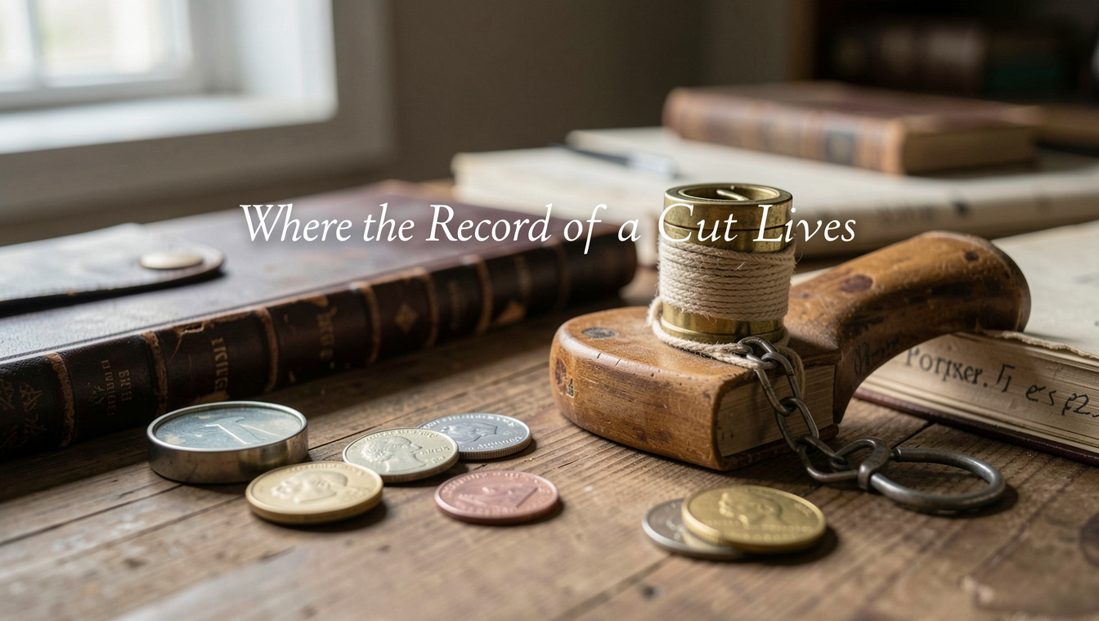
A league table keeps results and points. A club magazine keeps the season as it was lived. A wrap record keeps a batch, a cut and a measurement. Three records, three different kinds of memory, and none of them substitutes for the others.
What does a league table actually keep?
A league table keeps the smallest possible unit of a season: the outcome of each game, reduced to a win, a loss, an overtime result, and the points that follow. Everything else, the shot totals, the injuries, the travel, the mood in the room, is dropped at the door. What remains is comparable across the whole league, which is the point. A table is not a story. It is an index.
That index has rules, and the rules differ by league and by season. In the DEL, DEL2 and Oberliga, the columns and the tiebreakers are set by the competition, not by the reader. A team can finish level on points with another and still be placed differently because of goal difference, head-to-head results, or a regulation that changed between seasons. Anyone reading a table without the regulation beside it is reading half a document.
The limits are worth stating plainly. A table tells you what happened in the games that counted. It does not tell you how a roster changed in November, which goaltender carried the load, or whether a late run was real or a schedule artifact. For that, a reader has to go elsewhere. German-language coverage of the DEL, DEL2 and Oberliga, along with the rules, positions and statistical databases behind them, is gathered at the Eiskante hockey magazine, which is written for spectators, amateur players and parents rather than for front offices.
What does a club magazine keep that a table cannot?
A club magazine keeps the parts of a season that a table has no column for. It keeps the debut, the return from injury, the away trip that went wrong, the volunteer who has run the gate for eleven years. It keeps names attached to events, and it keeps them in the order they happened.
That is a different kind of record, and it has its own failure modes. A club magazine is written from inside the club. It is not neutral, and it is not trying to be. What it preserves is perspective: how a season felt to the people in it, which is exactly what a table strips out. Read together, the two documents correct each other. The table says a team finished sixth. The magazine says the sixth place was sealed on a Tuesday in February with a backup goaltender in net.
Neither document is complete. A magazine misses games it did not cover and people it did not interview. A table misses everything that is not a result. The useful habit is to treat them as two instruments measuring different things, not as a long version and a short version of the same thing.
What does a wrap record keep of a batch, a cut and a measurement?
A wrap record keeps three things, and it keeps them at a level of detail that neither a table nor a magazine attempts: the batch, the cut, and the measurement.
The batch is the production run. A roll of film is made in a lot, and the lot has a date and a set of process conditions attached to it. When a wrap is applied to a shaft, the batch is what allows anyone later to say which material was on the shaft, not just which color. Without the batch, a record is a description. With it, the record is traceable.
The cut is the shape taken off that batch. A wrap is cut to a length and a width, and those two numbers decide how the film sits on the shaft, how much overlap there is, and where the edges land. A cut is reproducible in a way that a hand-trimmed piece is not. Two wraps from the same batch, cut to the same dimensions, are the same object for record-keeping purposes. Two wraps from the same batch cut differently are not.
The measurement is what was actually observed on the finished shaft. Length, width, position relative to a reference point, and the conditions at the time of application. A measurement is only as good as the reference it is taken against, and a measurement without a stated reference is not a record. It is a number.
Why keep a record of a batch at all?
The honest answer is that most people never need one. If you wrap a dozen shafts for your own use and nothing goes wrong, the batch number is a curiosity.
The record earns its place when something has to be explained. A film that behaves differently from the last roll, an edge that lifts earlier than expected, a color that reads differently under arena lighting than it did in the shop: in each case the first question is whether the material changed or the application changed. A batch number answers half of that question immediately. Without it, the only available answer is a guess, and guesses do not accumulate into knowledge.
The same logic applies to the cut. If a wrap pattern is reproduced across a set of shafts, the cut dimensions are what make the set a set rather than a collection of similar-looking pieces. A record of the cut is what lets someone else reproduce it later without measuring your work by eye.
How long does each record stay useful?
Each of the three records has a different useful life, and it is worth being clear about which is which.
A league table is useful for as long as the competition's rules stay stable. Change the tiebreakers and the old table becomes harder to compare against the new one. The results do not change, but their meaning shifts.
A club magazine is useful for much longer, because it records things that do not get re-derived. A game report from a decade ago still tells you what the room was like. It does not become wrong when the league reorganizes.
A wrap record is useful for as long as the batch, the cut and the measurement can still be matched to a physical object. Once the shaft is gone, the record describes something that no longer exists, which is not the same as being useless. It is the only remaining evidence of how that object was made.
What a season keeps, and what it drops
The three records are not ranked. They answer different questions. A table answers who finished where. A magazine answers what the season was like. A wrap record answers what was on the shaft, cut to what dimensions, measured against what reference.
The habit worth taking from all three is the same: write down the thing that will be hard to reconstruct later, and write down the reference it was measured against. A result without a rule is a number. A story without a date is an anecdote. A measurement without a reference is a claim. The records that survive a season are the ones that kept their references attached.