Film and gauge
Reading a Class Rule as a Document
A one design class specification is a document with a scope and a date. The same reading discipline applies to a wrap specification sheet.
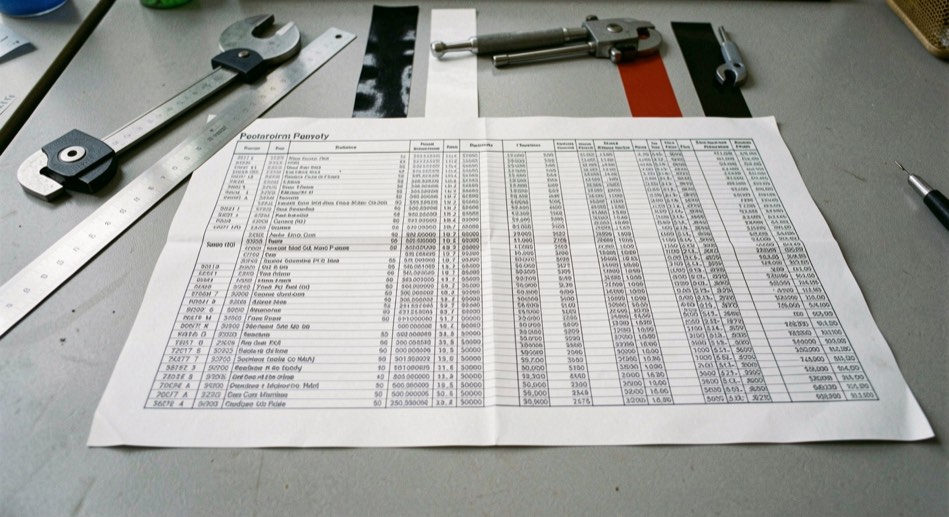
A class specification is not a description of a boat or a wing. It is a document with a stated scope, a revision history, and a set of figures that only mean something inside that scope. Read it the way you would read any standard: find who issued it, what it covers, what it leaves to the class, and when it was last checked. The same discipline applies to a wrap specification sheet, which is a shorter document with the same obligations.
What does a class specification actually contain?
A class rule for a one design boat is written to make two hulls or two wings interchangeable on the start line. It does that by fixing a small number of dimensions and leaving everything else open. The fixed part is usually short: overall length, beam, sail or wing area, minimum weight, and a few control points where a measurer can put a tape. The open part is longer, and it is where most of the reading work sits.
A class 8 kite buggy rule, for example, is not a general statement about buggies. It is a document tied to a class, a sanctioning body, and a set of specifications that a competitor can be measured against. The Cap Huit class 8 archive treats that rule as a document rather than a summary, which is the useful posture: it separates the current regulation from older papers, and it marks when each item was last verified. That distinction matters because a rule read without its date is a rule read wrong.
The structure of such a document tends to repeat across classes. There is a scope clause, a definitions clause, a measurement clause, and an appendix of diagrams. The diagrams are not decoration. They are the part a measurer actually uses, and they often carry tolerances that the prose does not repeat. If you read only the numbered clauses and skip the figures, you have read the intent and missed the numbers.
How do you read a standard without overreading it?
Read a standard in four passes, in this order.
First, the header. Who issued the document, under what authority, and on what date. A specification issued by a national body and adopted by an international one is two documents in one, and the adoption date is not the issue date.
Second, the scope. What is inside the document and what is explicitly outside it. Most misreadings come from applying a clause to something the scope excluded.
Third, the figures. Every number in a specification has a unit, a measurement method, and a tolerance. A minimum weight without a weighing procedure is not a rule, it is a wish. A dimension without a tolerance is not a limit, it is a target.
Fourth, the revision notes. What changed, and when. A clause that was tightened two seasons ago may still be quoted in its old form in forum posts and in older handbooks. The document is the authority; the commentary is not.
This is the same reading you would give a technical sheet for a film product. The sheet states a thickness, an adhesive, a temperature range, and a shelf life. Each of those is a figure with a method behind it, and each is only valid inside the conditions the sheet names.
What does a wrap specification sheet state, and what does it leave out?
A wrap specification sheet is a short document, usually one or two pages, and it does four jobs.
It identifies the film: product name, batch or lot where relevant, and the revision of the sheet itself. A sheet without a revision date cannot be compared to an older copy, and comparisons are the whole point.
It states the physical figures: caliper or thickness, adhesive type, and the temperature window for application. Thickness is normally given with a tolerance, because film is manufactured to a range, not to a point. If a sheet gives a single number with no tolerance, treat it as a nominal value and ask for the range.
It states the conditions: surface preparation, minimum and maximum application temperature, and the cure or dwell time before the wrap is loaded. These are the clauses most often skipped and most often responsible for a failure that gets blamed on the film.
It states the limits: expected service life under named exposure conditions, and the removability window. Both are conditional statements. A service life quoted without an exposure condition is not a figure you can use.
What the sheet usually leaves out is the method behind each figure. That is normal for a product sheet, and it is why the sheet is a starting point rather than a full standard. When a figure matters to a decision, ask for the test method and the sample size behind it.
Where does the analogy between a class rule and a wrap sheet hold?
The analogy holds in three places and breaks in one.
It holds on scope. Both documents are written for a defined use, and both become misleading when applied outside it. A class rule written for measured competition does not describe a recreational setup. A wrap sheet written for a prepared substrate does not describe an unprepared one.
It holds on revision. Both are living documents. A class rule is amended between seasons; a product sheet is reissued when the film or the adhesive changes. In both cases the current version is the one that counts, and the date is part of the figure.
It holds on tolerances. A class rule fixes a dimension within a tolerance because manufacturing cannot hit a point. A wrap sheet gives thickness within a tolerance for the same reason. Reading either as an exact value is a category error.
It breaks on enforcement. A class rule has a measurer and a protest procedure. A wrap sheet has neither. Compliance with a wrap sheet is verified by the result, not by an official, which means the reader carries more of the burden. That is an argument for reading the sheet more carefully, not less.
How should you record what a document says?
Record four things for every figure you take from a specification, whether it is a class rule or a wrap sheet: the value, the unit, the source document with its revision date, and the condition attached to it. A figure without those four is a number you will have to look up again, and possibly get wrong the second time.
Keep the documents themselves. A class archive that preserves older rule versions lets you see what changed and when, which is how you date a claim you find elsewhere. A wrap sheet kept with its revision date lets you compare a current product to the one you used two years ago, and to notice when a figure has moved.
The habit is the same in both cases: treat the document as the authority, treat the date as part of the figure, and treat anything you cannot trace back to a named source as a note rather than a fact.
What a document cannot tell you
A specification, of either kind, cannot tell you whether the thing it describes will work in your conditions. It can tell you the range it was written for. The gap between the two is where judgment lives, and no sheet closes it.
That is not a defect of the document. It is the boundary of what a document is for. Read the class rule to know what is measured. Read the wrap sheet to know what is stated. Then measure your own conditions against both, and write down what you find.